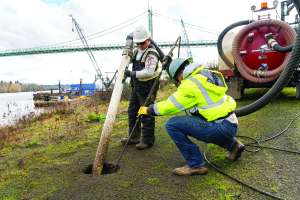

In Charleston, South Carolina, preserving history is not optional. From centuries-old homes along Rainbow Row to university residence halls that cannot afford downtime, excavation is often the last acceptable solution. So for Palmetto Pipe Lining, trenchless technology has become the tool that protects both infrastructure and heritage.
Led by 21-year-old co-owner Colby Nicholson, the three-person operation has quickly earned a reputation for taking on the jobs others hesitate to touch — 2-inch cast iron lines hidden behind irreplaceable historic finishes or a time-sensitive campus sewer rehabilitation completed over a compressed winter break.
Young in age but disciplined in execution, Nicholson represents a new generation of trenchless contractors focused on training, process and long-term growth.
Wise beyond years
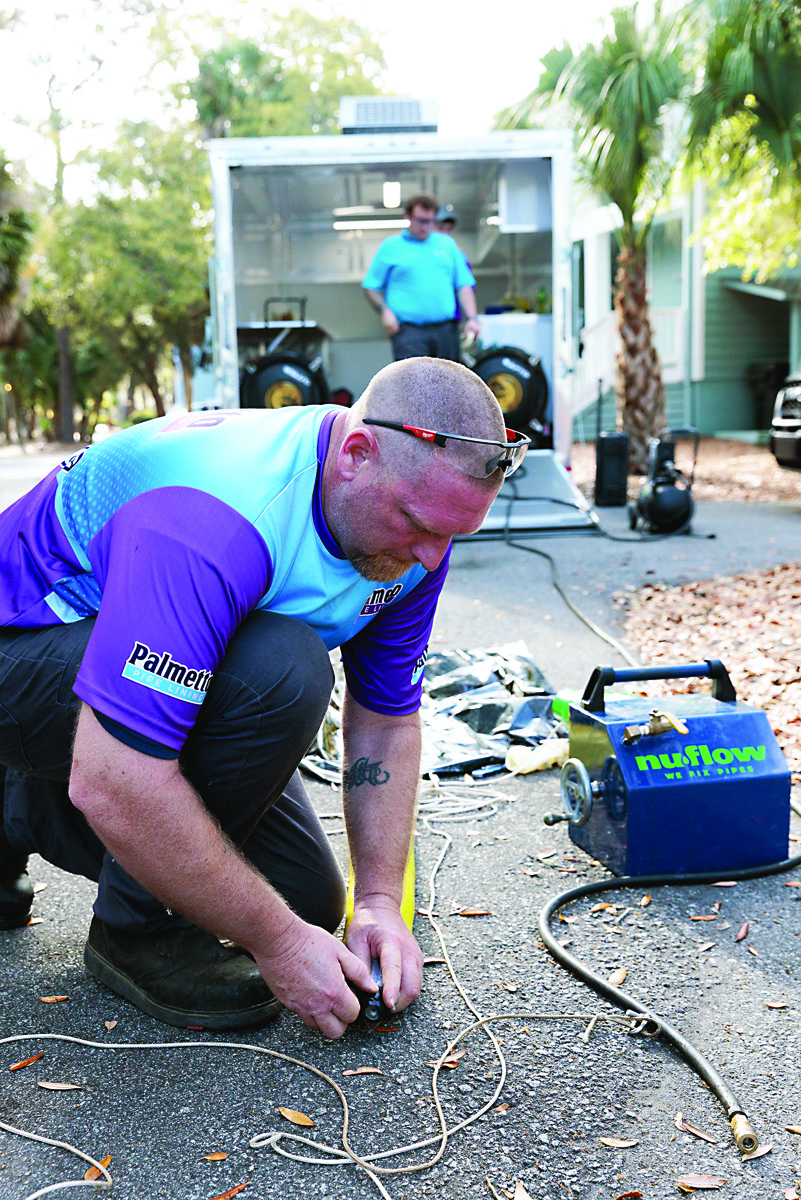
Most contractors spend their early 20s learning the trade. Nicholson, on the other hand, is already leading a trenchless division built on discipline, training and technical precision, making strategic decisions about equipment, process and growth that many contractors do not face until much later in their careers.
Palmetto Pipe Lining operates out of Charleston but serves clients across South Carolina and coastal Georgia, including Savannah. While the company officially separated from its plumbing parent just over a year ago, its growth has been steady and intentional.
“There’s only three of us,” Nicholson says. “We’re small, but mighty because we stay trained, and we don’t limit what we’re willing to take on.”
That philosophy of avoiding shortcuts, investing in skills education and saying yes to technical challenges has defined Palmetto Pipe Lining’s rapid ascent. It is also striking coming from a contractor barely out of his teens.
Nicholson entered the industry at age 17, discovered CIPP lining and quickly realized trenchless rehabilitation offered something traditional excavation could not: precision without destruction.
“When I first got into plumbing and saw dig jobs tearing apart people’s homes, I thought there had to be a better way,” he says. “When I found trenchless, I knew that was it.”
Family plumbing roots
Nicholson’s path into trenchless began inside a family business, but not in a straight line. His father had already built a foundation with Palmetto Plumbing and Drain, serving the Charleston market for years. As a teenager, Nicholson stepped outside the family company to work for another contractor. It was there he was first introduced to CIPP lining.
“I got into CIPP at 17,” Nicholson says. “And I loved it. I loved how efficient it was and how you could fix something without tearing everything apart.”
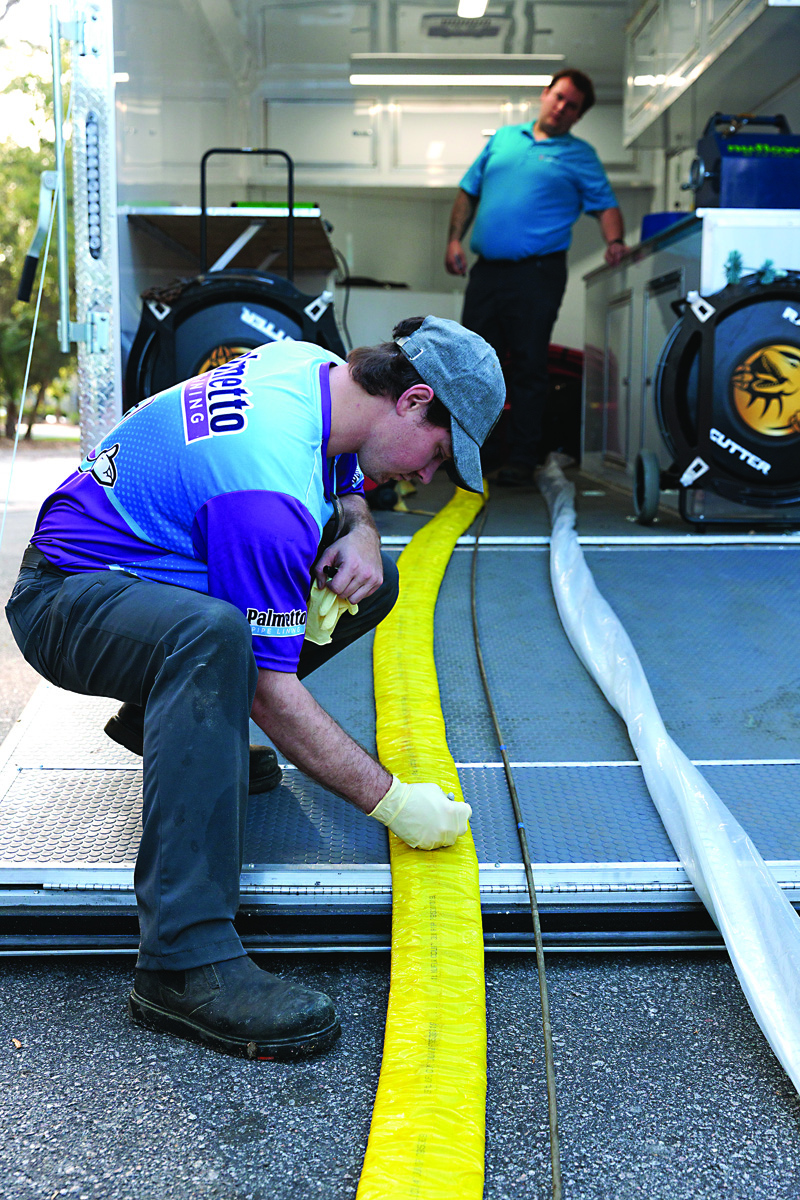
After a short time away from the industry, he realized trenchless rehabilitation was the direction he wanted to build his career. He returned to his father with a proposal to add trenchless services to the plumbing company and see where it could go.
They started with pull-in-place systems and smaller rehab projects. At first, installations were modest with only a few per month. But Nicholson approached the new offering differently than a typical add-on service. Every drain cleaning call became an opportunity to educate. Every camera inspection became a conversation about options beyond excavation.
“We talked about it on every job,” Nicholson says. “If we put a camera in and saw a problem, we explained trenchless. We showed people.”
Word began to spread. Referrals came from customers who appreciated avoiding disruption. More important, referrals began coming from other plumbing contractors who did not want to invest in trenchless equipment or assume the liability of installations they performed infrequently.
“There are a lot of plumbing companies that aren’t interested in investing in their own equipment or have the infrastructure to keep people trained at the level required to mitigate risk,” Nicholson says. “So they call us.”
Within six months, the trenchless side of the business had gained enough traction to justify its own identity. Roughly a year ago, Palmetto Pipe Lining officially separated from the plumbing company and became a standalone brand. The split was not about distancing from plumbing. Rather it was about focus, Nicholson says. By creating a dedicated trenchless division, he could invest more intentionally in equipment, training and marketing.
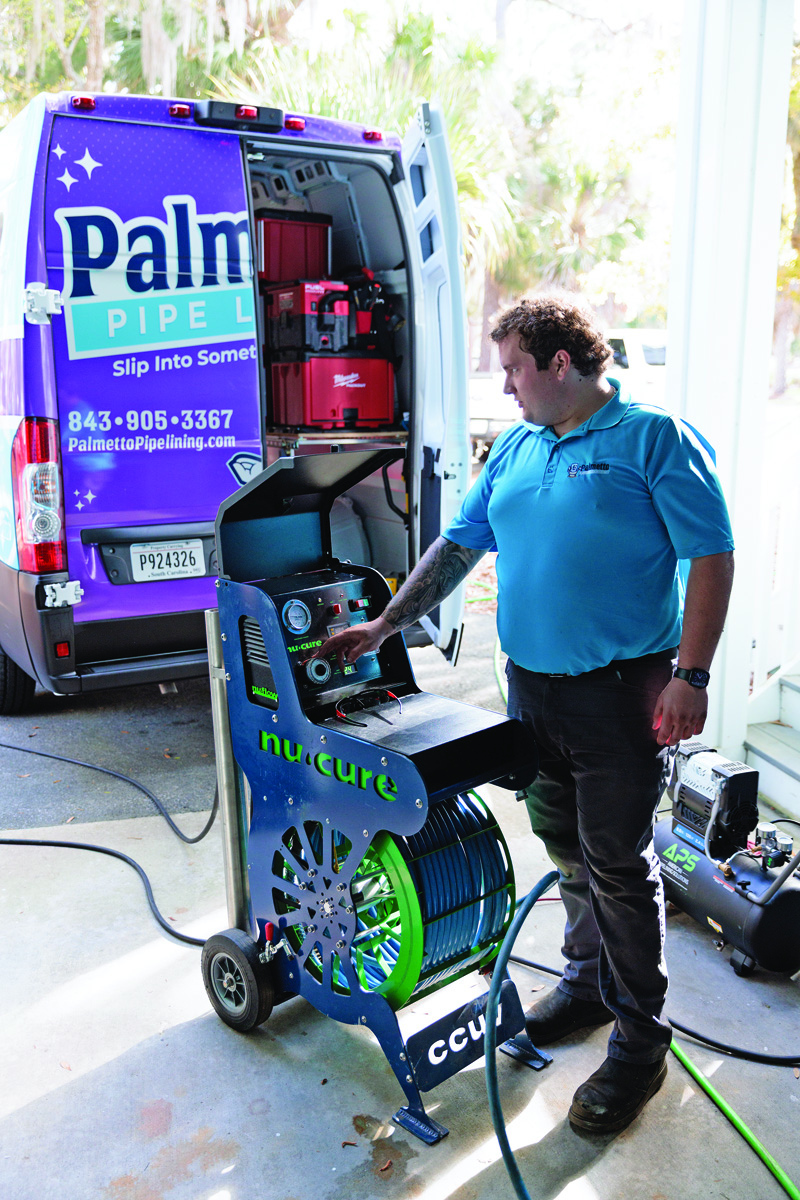
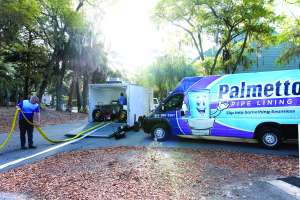
Today, the trenchless side operates with a dedicated van, multiple trailers and a growing inventory of lining and other trenchless repair systems.
A full toolbox
While many small contractors narrow their focus to one system or one diameter range, Nicholson has intentionally built Palmetto Pipe Lining around versatility. The company performs traditional services such as drain cleaning, jetting and camera inspections, but trenchless rehabilitation is the primary focus. Their capabilities include epoxy coating from Picote Solutions, NuFlow Technologies pull-in-place lining and inversion lining using Bluelight cure technology from HammerHead Trenchless. Cleaning and prep are performed using a variety of tools that include a descaling machine and Raptor cutter by American Pipelining Solutions, Renzorato cleaning tools and a skid-mounted Brute jetter from JETTERS NORTHWEST.
Nicholson is adamant that no single technology fits every scenario.
“UV is great for most applications,” he says, “but there are situations where good old epoxy and felt still make sense. There’s an application for all of it.”
That mindset of investing in multiple tools and understanding when to deploy each reflects an operator thinking beyond quick wins. It also allows Palmetto Pipe Lining to handle one of its defining specialties: small-diameter pipe rehabilitation.
In Charleston’s historic district, infrastructure often predates modern plumbing standards. Cast iron, clay and even Orangeburg pipe are common. Inside older homes and commercial buildings, diameters shrink quickly and access is limited. Nicholson has positioned his company to line pipe sizes that many competitors avoid.
“We’ll go down to 1 1/2-inch and 2-inch. We don’t limit ourselves,” he says.
The ability to rehabilitate smaller diameters becomes especially critical in historic structures where demolition is not an option. In Charleston’s downtown corridor, including the famous Rainbow Row and the Battery, restoration costs can exceed the pipe repair itself. Specialty finishes, hand-laid brick and imported materials make excavation a last resort.
“Why would you destroy something that’s beautiful and original if you don’t have to?” Nicholson says.
Trenchless provides an answer that aligns with preservation. It allows infrastructure upgrades while maintaining structural and aesthetic integrity, something particularly valuable in a city built on tourism and heritage. But Nicholson is quick to point out that offering small-diameter lining is not about marketing. It requires precision and repetition.

“The liner is cheap until it’s in the ground,” he says. “If you’re going to mess something up, you better do it above ground before it goes in.”
That comment, delivered matter-of-factly, reflects the discipline that has guided Palmetto Pipe Lining’s growth. Rather than rushing installations, Nicholson emphasizes training, checklists and process.
“Don’t forget the basics. Follow the step-by-step,” he says. “When you try to shortcut it, that’s when you fail.”
For a contractor barely into his 20s, the emphasis on restraint and not speed is notable. It is also one of the reasons his three-person operation has been able to take on increasingly complex work without overextending.
A race against the calendar
A good example showcasing Palmetto Pipe Lining’s approach occurred this past winter. The company was approached by a local plumbing contractor regarding recurring sewer issues at a Charleston college residence hall. Multiple clogs and failing underground lines had created an urgent need for rehabilitation. The catch was that the work had to be completed during a narrow winter break window while students were off campus. Once classes resumed, access would be limited and downtime unacceptable.
Planning began months in advance. Camera inspections identified deteriorating 5- and 6-inch cast iron lines beneath the facility. Corrosion, cracking and heavy scale buildup had reduced interior diameters and restricted flow.
Since the project had been in the works since summer, once the college gave Palmetto the schedule of when the students would be out, they had to be ready to mobilize. The timeline allowed roughly two weeks including the Christmas and New Year holidays. Realistically, that meant even less time as holiday days themselves were off-limits. For a three-person crew, the margin for error was thin.
All about the prep work
While lining often receives the spotlight, Nicholson emphasizes that preparation determines success, particularly with aging cast iron. In this case, scale buildup was significant — 5-inch lines had constricted to near 4 inches in places; 6-inch lines had narrowed to approximately 5 inches. Tuberculation and corrosion required aggressive mechanical cleaning before rehabilitation could begin.

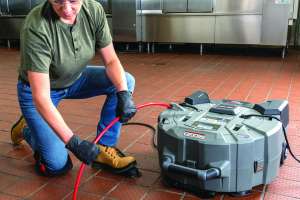
Using high-speed drain cleaning equipment from Renzorato with chain knockers, sanding tools and specialty cutters from American Pipelining Solutions, the crew made multiple passes to remove scale and restore interior profile. Jetting followed mechanical cleaning, and in several runs the process was repeated until inspections confirmed acceptable conditions.
“For each line, it could be half a day of cleaning,” Nicholson says. “We had to be strategic with our tools and not rush it.”
During the winter break window, Nicholson and his team worked extended shifts. Some evenings stretched to 2 a.m. Cutting reinstatements, preparing liners, mapping tie-ins and staging the next day’s work became a cycle of constant movement.
“We were cleaning, measuring, mapping every tie-in, loading the drum for the next morning,” Nicholson says. “It was a lot of man-hours.”
HammerHead Bluelight curing technology proved critical in meeting the deadline. The system allowed the team to control cure timing precisely, reducing uncertainty and eliminating concerns about resin kick times during staging.
“Bluelight saved us,” Nicholson says. “It made the timeline possible.”
By the end of the window, approximately 200 feet of pipe had been rehabilitated at the residence hall, along with dozens of lateral reinstatements. An additional building on campus saw more than 100 feet rehabilitated within the same timeframe. Most important, the work was completed before students returned.
For Nicholson, the project reinforced something he already believed: preparation, not speed, is what allows small crews to perform at a high level.
Preserving history
If the college residence hall project showcased Palmetto Pipe Lining’s ability to perform under deadline pressure, a historic downtown renovation demonstrated why Nicholson refuses to limit his company’s capabilities by diameter.
During a restoration on Rainbow Row, one of Charleston’s most recognized historic corridors, contractors discovered approximately 20 feet of deteriorated 2-inch cast iron concealed behind a specialty wax veneer wall finish. The finish was highly specialized and not easily replicated, Nicholson says. Demolition would have required significant restoration effort and risked altering the historic integrity of the structure.
Instead, Palmetto Pipe Lining rehabilitated the pipe in place. Using a two-part epoxy liner system from Picote, the team restored the failing cast iron without opening the wall beyond necessary access points. The structure’s finishes remained intact, and the property avoided costly reconstruction.
Projects like this underscore the company’s niche in small-diameter rehabilitation, work many competitors decline due to perceived difficulty or limited repetition. That willingness to tackle what others avoid has become part of Palmetto Pipe Lining’s identity.
Growth partners
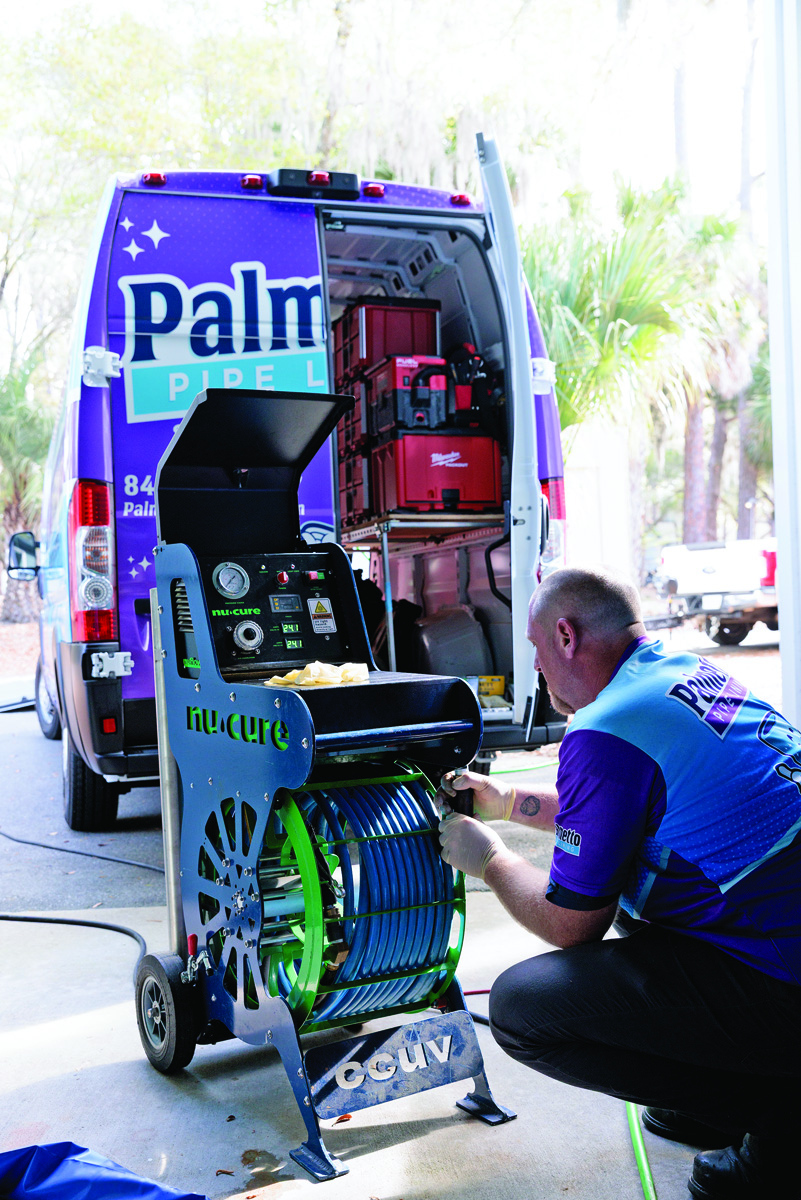
Nicholson attributes much of the company’s expansion to a balanced marketing strategy: old-school relationship building paired with modern digital visibility.
Referrals from plumbing contractors remain a cornerstone. Real estate offices and lunch-and-learn presentations help educate buyers and sellers about trenchless options. Trade shows and local networking events reinforce the company’s presence.
At the same time, Nicholson recognizes the importance of digital positioning.
“People aren’t just googling anymore,” he says. “They’re asking AI how to fix their pipe without digging it up.”
For a contractor his age, Nicholson’s decision to bring in outside guidance may be one of his most defining business choices. Rather than trying to grow the company entirely on instinct, he partnered with Pinnacle Trenchless, a consulting group specializing in trenchless business development and marketing strategy.
“I knew I didn’t know everything,” Nicholson says. “You can be good at installing liners and still not know how to scale a business the right way.”
Nicholson describes the relationship less as hiring a consultant and more as gaining a mentor. Through Pinnacle’s guidance, Palmetto Pipe Lining refined its pricing structure, strengthened its digital marketing presence and developed more intentional outreach to referral partners and real estate professionals.
“They handle our SEO, our Google presence and digital strategy, but it’s more than that. It’s talking through ideas, planning trade shows, structuring presentations, figuring out what actually moves the needle,” Nicholson says.
The results were measurable. What had once been occasional trenchless inquiries grew into a steady flow of calls each week. More importantly, Nicholson says the mentorship reinforced something he believes strongly: Technical skill alone does not build a sustainable company.
“You can’t do everything yourself,” he says. “If you try, you’ll burn out or you’ll stall out.”
For a 21-year-old contractor to actively seek mentorship and credit it publicly reflects a level of business maturity uncommon at any age.
“I’d tell any contractor thinking about growing: Don’t be scared to ask for help,” Nicholson says. “Find somebody who’s been there and learn from them.”
Nicholson represents a new generation of trenchless contractors who are technically fluent, digitally aware and focused on repeatable systems rather than fast expansion, a foundation for long-term growth.
Palmetto Pipe Lining may still be small in size, but its foundation, built on mentorship, training and strategic investment suggests it is anything but limited.
Continue reading for free