Here’s a funny thing about this industry: What feels routine to you might still feel revolutionary to someone else.
Pipe lining is a perfect example.
If you’re involved in trenchless work on a daily basis, it’s easy to forget just how remarkable it may all seem to someone on the outside, not in the know. You can rehabilitate underground pipe without completely tearing up a large portion of ground? How is that possible?
That used to be me a little over a decade ago when I first came to work for COLE Publishing. I was entirely unaware of pipe lining and learning about it was novel to me, like it was brand-new technology. Of course it wasn’t at that time. It was simply brand-new to me.
Now pipe lining feels commonplace. Routine. That is until I mention it to a friend or family member in conversation and they’re as clueless as I once was about it. I’m reminded that as much as pipe lining has grown and evolved, there are still currently plenty of people — contractors and customers alike — who are just being introduced to it for the first time. Members of the public who previously assumed the only way to replace or repair underground infrastructure was creating a large excavation. Contractors likely at least aware of pipe lining’s existence but only now looking at it as an addition to their service offerings.
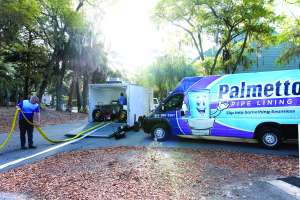
I thought about this in relation to one of this month’s featured contractors, Palmetto Pipe Lining out of Charleston, South Carolina. Owner Colby Nicholson was only 17 when he got his first taste of pipe lining while working under another contractor.
“When I first got into plumbing and saw dig jobs tearing apart people’s homes, I thought there had to be a better way,” Nicholson says. “When I found trenchless, I knew that was it.”
He quickly shifted his focus entirely on that service, bringing it into his family’s plumbing company first before eventually making Palmetto Pipe Lining its own entity. Nicholson, now 21, and his company are doing really well, taking pride in their ability to handle tricky jobs, like in Charleston’s historic areas where a lot of care and precision are needed to rehab infrastructure.
Only a few years ago, Nicholson was in the “What’s pipe lining?” camp. Now he’s a pro, while also still learning. He’s big on continuing education and not afraid to seek out mentors within the industry.
“Don’t be scared to ask for help,” Nicholson says. “Find somebody who’s been there and learn from them.”
That’s another piece of all this. I’ve noticed multiple examples of contractors doing plenty of their own pipe lining work but also, as a side venture, getting into the training and support services side for fellow contractors new to the lining game. I see that sort of thing continuing. Underground infrastructure continues to age and the demand for efficient solutions like pipe lining is only going to continue to grow.
If you’re someone with a story in the same vein as that of Palmetto Pipe Lining and Nicholson, I’d love to hear it. How did you first learn about trenchless solutions like pipe lining? What was your approach to getting educated and trained on it in order to be able to add it to your service menu? How do you educate customers still unaware of such trenchless options?
Because while pipe lining may be the everyday routine to some, it’s still new to many. It’s important to share stories and learn. That’s how an industry grows.
Enjoy this month’s issue.
Continue reading for free