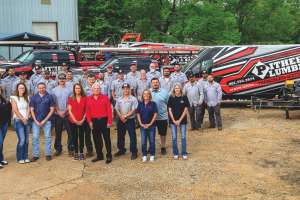

Family-owned Pither Plumbing is a 74-year-old success story characterized from day 1 by hard work, imagination and gumption.
That combination of management traits was true of company founder Jack Pither, his son Pat Pither, and now third-generation owner Patrick Pither. A propensity for reasonable risk-taking seems to be a genetic marker.
The tools of the trade have changed through the years, of course. Spades and pipe wrenches were the mainstays back in 1952. Today the company toolbox includes inspection cameras, jetting trucks, CIPP and pipe bursting systems, sensitive leak detection equipment and artificial intelligence.
The eastern Texas company, based in Longview, has broadened its mission from solving pure plumbing problems to resolving related infrastructure issues as well — this ability to evolve with the market being another longstanding company trait.
Breaking a slump
Pat Pither dropped out of high school his junior year to work full time with his father, Jack. He became a journeyman plumber at age 16 and a master plumber at 18. At that time, the company primarily plumbed new residential construction.
The 1980-81 recession ended such work. It produced a slump in the industry that pummeled Pither Plumbing as it did many other firms, ultimately shrinking the Pither workforce from about 90 employees to only two — Pat Pither and one helper.

At that point, the second-generation owner opted to shift the company’s focus to service plumbing. In the following decade, Pat Pither called on restaurants, apartment complexes and other potential plumbing service customers, winning them over with responsive 24/7 service and recharging company growth. By the end of the 1980s, he was back at a desk in his office overseeing a rebuilt organization.
Pat Pither’s business acumen wasn’t solely utilized to rescue Pither Plumbing. In an auxiliary venture, he got back into new construction in a novel way, partnering with several other businesspeople building hotels in the region. The deal was that he would plumb each new commercial structure in return for an ownership stake in the hotel. In that way, he eventually became part owner of several east Texas hotels.
Coming on board
Patrick Pither, 49, is carrying on the family tradition of growing the company through innovation, original thinking and nerve.
“I’m a problem-solver,” he says.
All this from a guy who upon graduating from high school “didn’t want anything to do with plumbing.”
After a time making a name for himself outside the plumbing industry, his father called in 1999 with the idea that Patrick leave the company to come home to help run Pither Plumbing. Finally, he acquiesced. Six years later, his father fully handed off operations to him and moved to South Padre Island to build condos, later formally transferring ownership to his son.
During this transition period, a Longview plumbing competitor, Clay Kiper, approached the Pithers with the suggestion that they buy out his firm. Kiper was persuaded to come aboard.
“From that point on, I had a veteran who could be my eyes and ears in the field,” Pither says.
It was an example of his willingness to partner with capable peers.
“I have been smart enough to surround myself with super intelligent, like-minded people” who also are OK with change and new technologies.

Seeking solutions
In 2005, Pither began to imagine a different future for Pither Plumbing. He visited the annual Pumper & Cleaner Expo — now known as the WWETT Show — where he saw a jetter and told himself, “I think we need one of those.” He subsequently purchased one.
The following year, he returned to the show, his mind still open to trying new things, and concluded: “I don’t know what this pipe bursting is about, but I think we might need one of those.”
No sooner had he returned home from the show than the suspected need became an urgent reality. A local school district called with a problem. It had discovered bad sewer lines under its newly remodeled library. “Do you know how we can replace that sewer without tearing up everything?” Pither was asked. As it turned out, he did. He bought a pipe bursting system (subsequently trading it in for a HammerHead Trenchless machine that’s still in his equipment yard), quickly got up to speed with it and successfully completed the job. It led to three other projects with the school district totaling $250,000.
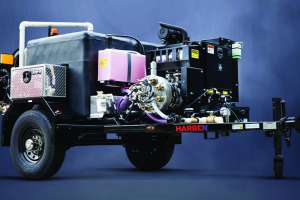
Just like that, Pither Plumbing was into trenchless solutions. The company added CIPP lining in 2019. In the equipment yard today are a Versa-Light CIPP system (American Pipelining Solutions) with SpeedyLight UV curing (Sewertronics) and a Dancutter SUPER FLEX reinstatement tool to restore laterals, as well as two O’Brien jetters — an 18 gpm model and a 32 gpm unit — and a Mongoose Jetters 42 gpm model.
When digging is required, two mini-excavators are available, a Kubota KX121 and a KX 91. Dirt-hauling is accomplished with an International dump truck and 14-foot and 20-foot dump trailers. The company also has a Ditch Witch hydroexcavator and a more recently purchased Vermeer V800HD unit.
The hydroexcavation equipment is wildly popular with Pither Plumbing crews. The first unit was purchased in 2016.
“That thing started leaving the yard daily,” Pither says. “Crews use it for out-of-the-ordinary things. If they find a leak and a bunch of mud, the machine is used for a mud pump. To reach a water meter box and shut off a valve, they hydroexcavate. Employees started fighting among themselves about who was going to get to use the machine each day. So, a second one was purchased. Both are in the field daily.”
Dirt is hauled to each hydroexcavation site at the start of a project so that holes can quickly be refilled with fresh dirt, a same-day site restoration practice that surely pleases property owners. To complete this recycling of soil, a dewatering station is being constructed at the company yard where hydroexcavators will be unloaded, slurry drained away and the reclaimed soil eventually hauled as fill dirt to another excavation site.
Doing it yourself
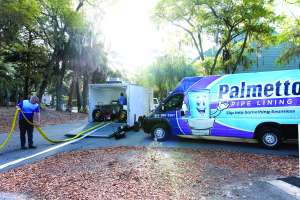
Such self-sufficiency is characteristic of Pither Plumbing. An example: The company operates a fleet of about 15 imaginatively wrapped trucks — half-ton pickups to heavier-duty Ford, Dodge and GMC models, Mercedes-Benz vans and an International dump truck. Plus two spare trucks. The company services this fleet in its own shop, a company mechanic working in the evenings to maintain vehicles.
“Whenever a truck goes down, we bring it in and, magically, it is ready to go in the morning,” Pither says. “I don’t want to have to depend on someone else, so we decided to just bring repairs in-house.”
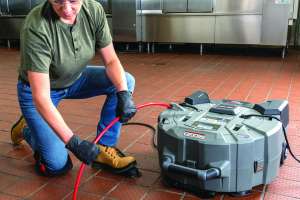
And vehicles are not the only equipment worked on. So are inspection cameras, cable machines and other pieces of trenchless technology.

“We have welders, plasma cutters — if something breaks, we rebuild it,” Pither says.
Or build it from scratch. That’s what the company did when technicians grew frustrated in their attempts to effectively descale 2-inch drainlines before lining them.
“We looked but all we found were skid units that were overpriced or glorified pressure washers,” Pither says.
So company fabricators designed and assembled a solution.
“We were able to source an engine, pump, hose reel and hoses and build it on a skid all for less than $5,000,” Pither says. “The unit will do 9.2 gpm at 3,500 psi. We installed it in a Sprinter van.”
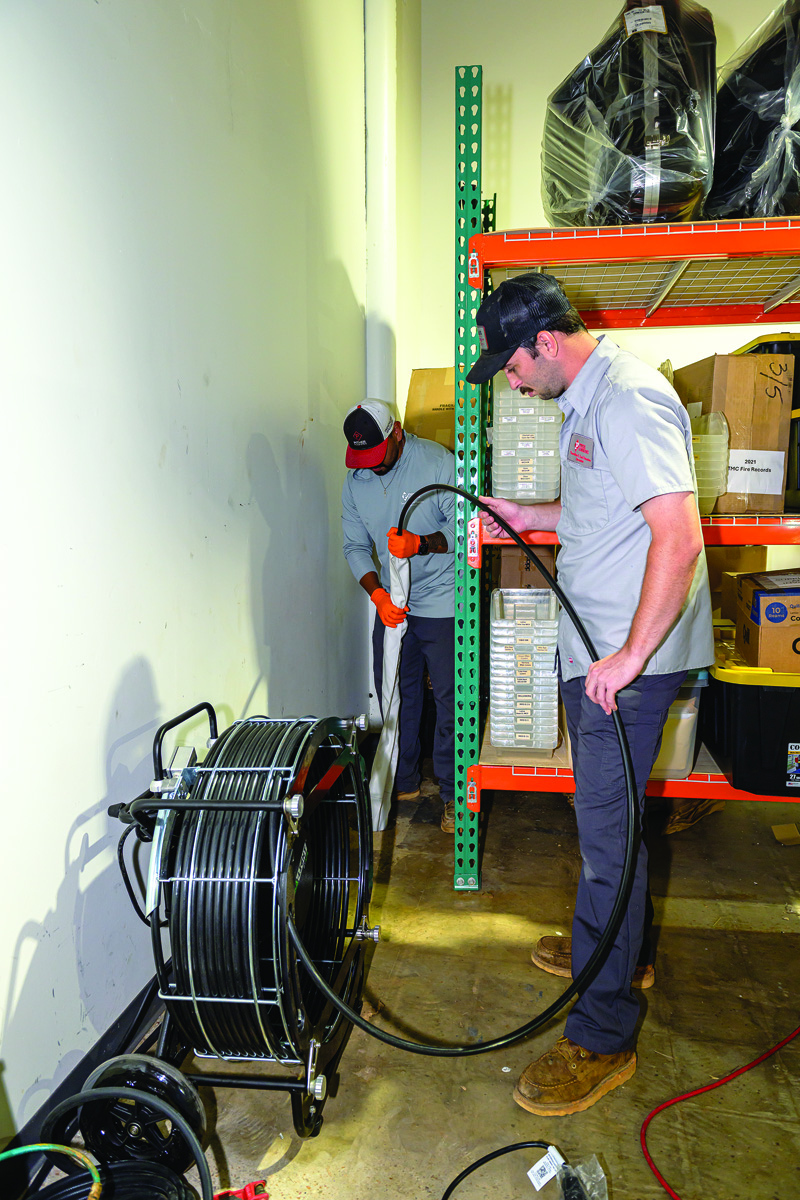
The overarching goal of such in-house work by shop and warehouse personnel is to keep customer-facing crews working in the field. Case in point: inspection cameras. Each truck has an American Pipelining Solutions camera. Two spare cameras are kept in the shop. If a video unit fails, a warehouse worker rushes a spare camera to the crew at its job site, collects the failed one and returns it to the shop where it is restored to a fully functioning state and eventually swapped out again.
Pither Plumbing partners with APS for all of its trenchless equipment as well as for trenchless training — either on site or at the APS office in South Carolina. The latest tech tool the company has embraced is the Versa-Patch spot repair system. For materials and small equipment, the go-to source is Coburn’s, a local wholesaler.
Doing it all
Traditional plumbing work and trenchless services have been seamlessly integrated at Pither Plumbing. There was a learning process in reaching such equilibrium, of course — mistakes were made and lessons learned.
In problem trenchless jobs early on, the company always persisted till it succeeded and customers were happy. While overcoming such difficulties was gratifying, even more satisfying were challenges met without a hitch. One that Pither recalls was a hospital that had an 8-inch sewer main fail beneath the building, threatening to temporarily shut down the facility.

Pither Plumbing techs quickly located where the line had failed, prepped it for lining, lined and cured it quickly with UV light, and reinstated laterals with the Dancutter. The medical facility was able to continue to function without interruption.
“That’s just one project where our crews showed why we dominate the market,” Pither says.
Residential plumbing service calls account for about 60% of Pither Plumbing’s business — water heaters, leaking toilets, waterline replacement. The remaining 40% of business volume is split among commercial, industrial and institutional plumbing clients, or trenchless and other underground projects for a wide range of customers. The company no longer does any new construction plumbing.
“We pride ourselves on our comprehensive suite of services,” declares the Pither Plumbing website. “Our goal is to be your one-stop solution.”
To that end, when a hole is opened in a paved parking lot to access a bad line, Pither Plumbing crews finish the job by patching the hole with new asphalt, or by laying rebar and pouring concrete.
“We pour cement somewhere almost daily,” Pither says. “I believe customers want to deal with one contractor.”
This “suite of services” is mirrored in the company’s suite of internal divisions. Three crews have been cross-trained to deal with most underground and trenchless undertakings. Another three crews are journeymen or master plumbers ready to resolve gas or water infrastructure issues. Most of the remaining teams are service techs running cameras through drains and otherwise dealing with stoppages and failed lines. Finally, one journeyman plumber is the company’s leak specialist trained to detect escaping water in a slab or wall, trace the path of waterlines in walls and basically locate and resolve any and all leakage issues.
Growing methodically

That lineup of specialists is not complete, however, because Pither isn’t finished imagining the future and building out his company. He recently hired an artificial intelligence specialist to further automate internal processes and speed up the behind-the-scenes work of managing an increasingly sprawling operation.
“We can do more in-house and it will take me less time,” Pither says. “Nothing will get us away from being in the trenches, but the AI will make things easier. Less paperwork.”
But there’s a limit to taking advantage of such tools. Pither adds that he has no intention of automating customer service calls. Callers will not be talking to AI chatbots.
More to the point, a whole new chapter of the Pither Plumbing story is about to be written.
“I am in negotiations with a contractor to purchase an HVAC business,” Pither says.
If negotiations are successful, the business will be incorporated into the company, adding several new HVAC crews to the Pither Plumbing lineup of specialty teams.
Pither says he is “pretty methodical” when it comes to considering new technology or, presumably, when assimilating whole new divisions into the company. He says he and a couple of key employees always do their due diligence.
“We don’t make knee-jerk decisions,” he says.
Whether it is taking on a new trenchless tool, the absorption of another company into the fold or — as is also being mulled over at this time — establishing a satellite branch about 40 miles away in Tyler, Texas, the final decision will be well thought out and, if history is any judge, prove to be a sound one.
Continue reading for free