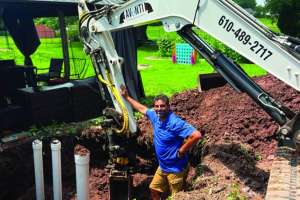
To run a more efficient and profitable business, second-generation plumber Rich Stob — the owner of Stob Plumbing in suburban Chicago — firmly believes in playing small ball, as in a small geographic footprint, a small staff of employees and small jobs.
The biggest benefits of this approach? The ability to respond quickly to customers’ needs, a better work-life balance for him and his two technicians, and fewer worries about hiring more employees, buying more service vehicles, meeting more business expenses and other related hassles, he says.
“Keeping things small helps me better manage our service work,” says Stob, 46, whose company is based in Tinley Park, located in southwest suburban Chicago. “I like to clean our plates by the end of the day, so that we can get a quick start the next day. I don’t like to take on too much work because I want to be available for clients that need us right away. Our slogan is ‘first in service,’ and by operating this way, we can be Johnny-on-the-spot when customers need us.”
Small time
Stob concedes that this business model leaves revenue on the table. But the flip side is that taking more jobs would require more employees, more service vehicles, more business expenses and so on, not to mention the added pressure of always striving to ensure there’s enough work to keep technicians busy.
“I decided to keep our geographic footprint small — keep a tight service area of roughly a half-hour’s drive from our shop,” he says. “I don’t need to be a hero and take every service call that comes along. I like to be home by 5:30 every night because I still have younger kids and want to maintain a good work-life balance. It’s better for everyone this way — customers get serviced quickly, trucks don’t get beat up and technicians don’t get stressed out.”
Stob says this approach — coupled with using time-and-materials pricing, which he believes is more fair than flat-rate pricing — have been keys to the 48-year-old company’s success and longevity.
“Our customers know we’re always available,” Stob says. “And we’ve been around so long that people know us and trust us. They know we’ll be prompt and responsive.”
The small-ball approach also helps with technician retention. While Stob works weekends, the company’s two technicians — Charlie Alsip and Brian McCann — only do so if they want to.
“One of my guys likes to work 40 hours a week because he has kids, and I’m good with that,” Stob notes. “He appreciates that. My other guy likes to work more than 40 hours. But we’re not beating them up — and they love that.”
Big wheels
But there is one thing that Stob is big on: his service vehicle. His Chevrolet G3500 cutaway van with a Spartan utility body from Supreme Corp. (a company owned by Wabash National Corp.) carries roughly $50,000 worth of repair parts, fixtures, water heaters and the like.
The box body, which features roughly 576 cubic feet of cargo space, reduces the amount of time spent traveling back and forth to parts depots, which is a profit-killer, Stob says.
“It’s like a Home Depot on wheels,” he says. “It allows me to get jobs done quickly so I can move right onto the next job.”
The interior features a customized, self-fabricated storage system, including special racks for various lengths of pipes.
“A lot of guys carry pipes on the roof,” Stob notes. “But I like them better inside because smaller lengths are more accessible there. Digging around in those exterior tubes for pipes is just too hard and you just can’t fit as much pipe in them, either.”
The truck’s interior is spacious enough to hold three 75-gallon water heaters, 1,000 feet of pipes, faucets, pumps, power tools and so forth, plus four drain cleaning machines, a pipeline inspection camera and a pipeline locator. And there’s still room to accommodate a commercial 100-gallon, 5,000 Btu water heater, he says.
The company also runs a Chevrolet 1500 Express van and a Dodge RAM 1500 pickup truck with side bins; the truck is mainly used to tow a HotJet USA trailer-mounted water jetter.
Family business
Stob’s father, Garry, founded the company in 1977 with a business partner. The elder Stob and his partner parted ways around 1996 and Stob bought the company in October 2018 when his father retired.
“I was fully employed by my father since 1997 and worked for him since I was 15 years old,” Stob recalls. “I always thought it was pretty cool to work with him. I’m mechanically inclined, so I liked that part of it. And I like to work outside and work hard. I’ve always liked that. I used to rod sewers barehanded for hours. I dug holes all the time, too.”
Stob made no major changes when he bought the company, aside from updating some of the company’s equipment.
“I kept on operating on the same premise as my dad: make sure we can service customers quickly,” he says.
Subcontractor network
Unlike many companies that diversify services so they can operate as one-stop shops for customers, Stob says he prefers to serve as a general contractor of sorts, hiring out work he doesn’t do — like commercial sewer repairs — to contractors that he’s thoroughly vetted. He started doing this after he bought the company.
“The advantage is we can still get larger jobs done quickly and done well because I use contractors I’ve vetted,” Stob explains. “At the same time, I can still have my guys focus on service work that needs to be done daily. It allows us to provide all the benefits a bigger company can offer, but without all the headaches associated with hiring more employees, buying more equipment and so on.”
Stob relies on a network of subcontractors that provide a variety of services, ranging from carpenters and tile installers to electricians and drywall hangers.
“A lot of my clients are older and don’t know what to do or don’t want to hire more contractors, so they just say, ‘Rick, go ahead and take care of it.’ So I do.”
Stob says he carries contractors insurance that covers these subcontractors. His business model works because he has so many repeat customers that know and trust him. Furthermore, the contractors he uses often refer him to their customers with plumbing needs.
“They know me well and know I’ll do things right,” Stob says.
Equipment rundown
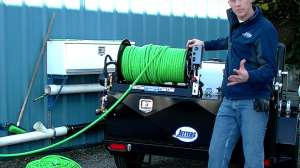
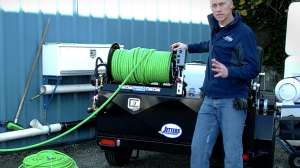
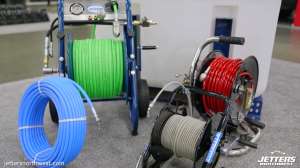
As the company grew, so did its fleet of equipment. It currently owns a trailer-mounted water jetter from HotJet USA that features a 350-gallon water tank and a water pump that generates flow and pressure of 10 gpm and 4,000 psi; and two cart-mounted water jetters — one from O’Brien Mfg., A Product of Hi-Vac Corporation and one from Spartan Tool — with water pumps that produce up to 5 gpm at 4000 psi and 3.5 gpm at 4,000, respectively.
For jetter nozzles, the company prefers Warthogs by StoneAge and Reapers from Hydra-Flex.
The company also owns several Spartan drum cable drain machines; drum cable machines from Milwaukee Tool, including one that features Powertredz stair-climbing capability; a Mini Miller drain machine from Picote Solutions; a sectional drain machine from Electric Eel; a flexiprobe push camera from Pearpoint; and a RD7000+ underground utility line locator from Radiodetection (a brand owned by SPX Technologies).
Stob also prefers jetter hoses from Piranha Hose products and cutters and other attachments from MyTana. The company owns a 16-foot utility trailer for carrying equipment, built by C&M Trailers.
Being one of the first companies in the area to invest in technologically advanced tools and equipment also has helped the company grow, Stob notes.
“We were the first ones around here to invest in a camera system,” he says. “We also were among the first to buy the ProPress system when NIBCO first brought it to the United States.”
Staying steady
Because of his business model, Stob doesn’t expect his company to grow dramatically in the coming years.
“I’m a God-fearing man and I feel very blessed to be what and where we are — a small and older plumbing company,” he says. “I like the fact that we’re like a small family unit and I feel very humbled by our success. I’m not trying to make a million dollars or buy a yacht. We just want to make a steady living and provide excellent service for our customers.”
Looking ahead, Stob says he plans to retire before he turns 60 years old. After that, he’ll probably sell the company.
“I have a son and he’s not going to be a plumber,” Stob says. “So I’ll probably retire, sell the company and move south. I’m not going to be that 78-year-old guy that keeps hanging out at the shop, yelling at the young whipper-snappers and rummaging through old newspapers.”