“More than two-and-a-half years after the hurricanes, our crews are still helping to restore full sewer service to the residents of the five parishes (counties) that constitute the Greater New Orleans Area,” says Trey Horne, operation’s manager for CES, based in Baton Rouge, La.
After leading a heroic effort that at times involved more than 180 combination trucks sent by contracting firms across the country, CES continues to rehabilitate the sewer systems and prepare them for hurricanes all but certain to strike in the years ahead.
National scope
CES, founded by CEO Kenneth Dutruch in 1994, is a full-service professional sewer evaluation, cleaning, and technical assessment firm. The company has seven branch offices in areas as far afield as Maryland and North Carolina.
Its staff of 105 includes civil engineers, environmental scientists, biological and computer scientists, and many skilled and highly trained support personnel. Other CES technicians are trained in high-pressure cleaning, monitoring, dye and smoke testing, manhole inspections, GPS Survey, and advanced GIS mapping.
This collection of talent helped the company face the enormous sewer rehabilitation tasks after the hurricanes.
Hurricanes Katrina and Rita, which hit in August and September 2005, constituted the largest and most costly natural disaster ever to strike the United States. Immedi-ately after Hurricane Katrina, CES was hired to clean and inspect the sewer systems in the New Orleans area. The company did so with its own crews and with assistance from other companies from as far away as New York and Idaho.
“Our work has been the result of a total effort by many forces, says Brad Dutruch, vice president and general manager. “There is little question that our job would have been significantly more difficult without the use of our fleet of combination vacuum trucks. It took our own crews, including two full-time mechanics, often working long, continuous hours, to get this job done.”
The company used combination trucks supplied by Vac-Con Inc. by way of the local dealer, Covington Sales. “Without the aid of new technology like GPS, and much help that we received from other contractors who came in from around the nation, I don’t think that we could have accomplished what we did,” adds Dutruch. “New Orleans alone had an estimated 58,000 catch basins and 3.5 million linear feet of storm drain lines to clear, clean and inspect.”
Residual damage
As it turned out, the original cleanup, as difficult as it was, did not completely resolve the problems in the sewer systems
“In doing this work, we have encountered several situations that only seem to have compounded the original damage,” says Horne. “Severely affected locations that were initially bypassed in favor of restoring the majority of the system are now creating even more problems.
“It appears in some instances that the force of the flood water entering the system caused the subsurface soils around the pipe joints or cracks to be hydroblasted. When the water was then pumped out of the city, the receding water carried that soil with it. This has undercut the aging sewer lines to the point of failure. Some streets and sidewalks are collapsing, causing disruption, blockage or infiltration to the lines.”
Another problem has been the blockage of once-cleaned lines by the influx of debris from the recovery effort. After simply being dumped curbside, awaiting pickup, some of that debris washed into the storm sewers during many subsequent rainfalls.
Looking ahead
Now, in a second and third phase of operations for various parishes, CES is following up the job of preparing the systems for future major storms. Included in the preparations are contracts with various governmental and geopolitical entities to clean, video inspect, and evaluate more than 1.8 million linear feet of storm and sanitary sewer work in and around parts of Orleans (New Orleans proper) and St. Bernard, Plaquemines, Jefferson and St. Charles parishes.
Previous contracts with the various entities gave CES valuable personal contacts and familiarity with the local neighborhoods — all helpful for logistical purposes.
“Now that we are finished with Phase 1, we are working on the second phase of the cleanout for the city’s Emergency Sewer System Assessment (ESSA) and the LADOT Federal Aid Submerged Roads project,” Dutruch says.
“In these operations, we are going back to areas we had to bypass initially. Yet we are still in the 9th Ward today. The problem here is that many of these sections are now even more difficult to clear. Much of the debris from residential cleanout and repairs was just dumped out into the streets in front of the houses. This has since flowed into the lines, making our job that more difficult.
“The city depends on smaller temporary pumps in the pumping stations to move the sewer flow. We are often forced to isolate lines, and in many instances, we depend on our Vac-Con trucks for bypassing these locations.”
Working in traffic
The CES crews are clearing lines that require them to work in main streets that now carry heavy traffic, including trucks carrying building material. The company would like to average 2,000 feet a day, but obstructions and other difficulties often limit them to about 1,500 feet.
Dudley Sullivan, a CES area foreman who lost his house in the hurricane, says the Vac-Con combination unit in the lower 9th Ward is equipped with a 12-cubic-yard tank. The normal procedure is to dump the tank once a week on a Friday, or sooner.
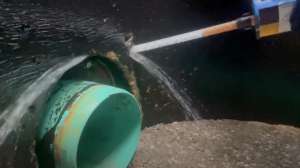
The operator, Limmie Sibley, says he uses the truck’s jetting system at 1,100 psi when driving the jet nozzle down the line and 800 psi when drawing the hose back. The manholes the crew uses to access the sewer are typically six feet deep with 8-inch sewer line connections.
Safety is paramount in all CES operations. Horne says the Vac-Con machines can easily be placed in traffic with the back end facing oncoming vehicles, minimizing the operators’ exposure to danger. All controls are on the front of the truck.
Video inspection
The Algiers section of New Orleans is another difficult work site. Here, the sewer line is located at the toe of the levee along the Mississippi River in an undeveloped area set apart from the residential district and accessible only by a rough gravel road.
CES personnel inspected sewers in the area using a CUES inspection camera coupled with that company’s Granite XP pipe survey and reporting software. Technician Bruce Walton manned the video monitor screens inside the CES inspection truck while operator Harold Knightshed handled the camera at the manholes. The two recorded video data in increments of up to 700 feet for later review and analysis.
“Immediately after the hurricanes, we had all the help we could ask for,” says Dutruch. “Immediate recovery was an essential goal for the Greater New Orleans area.
“Now that the emergency effort has subsided and there is a semblance of normality restored, the job is far from over. It is reliably estimated that it could take as much as ten more years to bring everything back to the way it once was.” With its capable staff and up-to-date equipment, CES is well prepared to get the job done.
Continue reading for free