While controlling main-line inflow and infiltration, the Rockland (Mass.) Sewer Depart-ment faced another challenge: groundwater migrating into the sewers through 6-inch vitrified clay laterals.
Heavy infiltration during spring and fall pushed the treatment plant’s limited capacity, affecting the town’s ability to grow. Repairing the laterals became the next major objective. An inspection by Metcalf & Eddy Inc., an environmental engineering company in Wakefield, Mass., identified leaking joints 20 feet up the service connections. The engineers decided that grouting was the most economical solution.
National Water Main Cleaning Co. (NWMCC) in Canton, Mass., a division of Carylon Co., won the repair contract. “We have years of experience sealing laterals up to eight feet, but this was our first attempt at such a distance,” says project manager Jim Falconieri. “The thought of all the things that could go wrong was daunting.”
With the help of a lateral packer manufacturer, a new combination TV/grout/cutter truck, and some tweaking of chemical recipes, NWMCC successfully repaired 34 service connections. That and similar projects will help the town plan for expansion without building a larger wastewater treatment plant.
Chronic area
Although installed in the 1950s, the clay laterals were in good shape; only their bell and spigot joints were leaking. “Grouting is used to control infiltration,” says Falconieri. “It’s not a structural repair.”
M&E had identified a neighborhood with chronic infiltration. Falconieri’s two men used a Lateral & Mainline Probe (LAMP) system from CUES Inc. of Orlando, Fla., to assess each service connection and pinpoint infiltration sources. Inspections were done during high groundwater conditions.
“Most leaks were in the one to four gallons per minute range with some exceeding 10 gallons per minute,” says Falconieri. “After reviewing the findings, we chose 34 laterals for sealing as part of Rockland’s program to reduce I&I.”
Falconieri asked Marc Anctil, president of Logiball Inc. in Jackman, Maine, to provide in-the-field training and advice. “Learning on the job made Gary Millington, my grout truck operator, and me very nervous,” says Falconieri. “We didn’t want to dig up yards to retrieve stuck equipment.”
Falconieri brought his newest truck, a combination TV/grout/cutter from Aries Industries Inc., and replaced its 15-gallon vacuum tank with a 30-gallon tank.
Long train to daylight
The lateral packer from Logiball has a 25-foot-long rubber hose, or carrier train, attached to the bladder launcher with pan-and-tilt camera. After the bladder is lubricated with silicone, vacuum retracts it though an opening at the head of the carrier train. “Whenever something that long is put in a sewer, anything can go wrong,” says Falconieri. A remote-controlled winch at the downstream manhole advanced the packer.
Millington had to learn how to get the carrier train into the mainline, position it, and inflate the bladder up the lateral. A maximum pressure of 40 psi seals the ends of the packer against the walls. “To achieve an effective seal of 20 feet, the packer travels 25 feet due to the plug at the end,” says Falconieri.
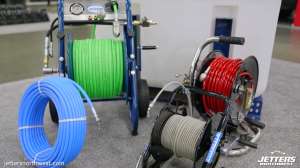
Separate hoses carried AV-100 liquid acrylamide grout and catalyst from Avanti International to the packer, where the chemicals mixed together as they were injected. “Marc increased the gel time from 10 seconds to five minutes because of the distance we pumped the grout,” says Falconieri. “It’s a catalytic cure, but with such long gel times, we didn’t know if the grout would gel prematurely or not at all.”
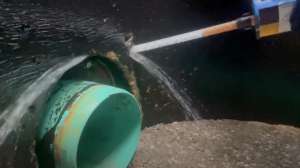
Although the forward end of the bladder seals against the lateral wall, its expansion is restricted to form an annular space. Grout flows through this passage, out the bad joints, and gels with the surrounding soil. Millington could see water running as the bladder approached the joint, and stop after the grout was injected. The average annular space held 12 gallons of grout. The most used in any repair was 26 gallons. Pressure monitoring told Millington when laterals were sealed.
Retracting the bladder was difficult because of its length and the friction created by residual grout in the pipe. “It’s not a solid skin coating, but a thin gelatinous mass,” says Falconieri. “Had we ruined the bladder, our profits would have gone with it.” Millington’s steady hand avoided damage.
Hold that flush
NWMCC notified residents when their laterals would be blocked, and asked those who stayed home not to flush toilets or use water during the repair. Rockland officials worked with NWMCC, answering homeowner questions. Even though the area was quiet, the crew coned off the CCTV truck, and a police officer controlled traffic.
Rehabilitations took 30 minutes, and three or four were completed each day. It took Falconieri’s team 11 days to repair the 34 laterals. “The surprise was how well it went,” says Falconieri. “With Marc’s help, we were sealing laterals like old pros after the first day. None of our fears materialized.”
The repairs enabled Rockland to attract more business and residents without spending millions to enlarge its wastewater treatment plant.
Continue reading for free