Hunter has owned the company for 20 years after having been an employee for 18 years. He introduced many of the services that make the business a formidable competitor. Customers include homeowners, municipalities, (generally below 100,000 population), industrial and commercial businesses, and farms.
Three elements are important to the business: maintenance and repair of the fleet, staff training, and experienced, hands-on management. With a reputation for prompt, efficient service, Roto-Rooter of Ogden is established with 14 Utah cities and sometimes serves cities in Idaho. Hunter prefers to work within 150 miles of home base. Residential work accounts for 60 percent of the business; 30 percent is municipal.
A broad base
Serving a broad customer base is challenging, but with wife and co-owner LaDawn, four office staff members, and 11 service technicians, Hunter keeps things humming, 24 hours a day, seven days a week. He gives customers his cell phone
number and even answers calls while on vacation. He also offers a personal, free visit.
“If a city calls with a problem, sometimes I’ll meet with their engineer,” Hunter says. “On a residential call, I go out at no charge, talk with the people, and find the problem. Then the crew will go back in to get it taken care of.”
“We maintain and repair our trucks and most equipment in-house,” Hunter says. “We do hose repair and tank repair. The guys who run the trucks know how to repair them. It’s cheaper for us to repair them. I’ve been repairing trucks from the beginning as an employee, and I now train our technicians.
“Often, we can make a repair while on the job, as we have spare parts on the trucks. If we blow a hose, we can repair it right on the spot. If we have a leak, we have parts here in our shop so we can repair it. Part of our plan is to get the job done and keep things going.” Work on the firm’s two camera trucks is handled by UEMSI at its repair shop in California. The company has its shop in a 60- by 100-foot heated building, which houses most of the fleet during cold weather.
Get it right
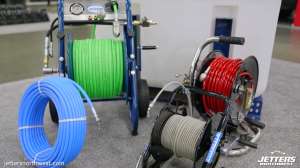
No matter who the company serves, Hunter believes in training. That applies especially to the company’s five FMC flusher trucks, each with a 1,250-gallon water tank and a pump delivering 1,800 psi/65gpm; and its five combination trailers from Hi-Vac Corp./Aquatech Products.
“It takes about a year and a half to really train someone to be boss on a flusher crew,” says Hunter. “The person has to learn what the high-pressure hose is doing — how it is cleaning and how it feels when they hit something going up the line. If it’s tree roots, or a low spot they will know what they’re dealing with. You can tell by the feel what the problem is. I tell people they have to use their imagination. You have to feel the hose as it goes up the line.”
If the problem is roots, he wants the operator to feel through the hose what is going on as they use the cutter. “A person who can’t do that does not belong on one of these trucks,” Hunter says. An employee who advances to head a flusher truck is assigned a helper.
“I may assign the person which city or customer to work for, but that person is then the boss of that truck,” Hunter says. “They know to go in and get the job done. Everybody does not make it to that level. Right now I have three guys plus myself. I wish I had two or three more.”
Trainees first work as helpers alongside Hunter or an accomplished technician.
Be the best
The company has not made it a priority to add services such as pipe bursting and pipe lining. “We find the problem and get the job ready for whoever will come in to complete that type of job,” Hunter says. “I’d rather be good at what I’m doing than to branch out to where I can’t do a good job. Finding personnel is hard. People seem to move from one job to another. However, once someone gets on a flusher crew they tend to stay with me.
“Residential work is actually more difficult, because the worker is pulling the cables in and out of the house, whereas in commercial work the technician is handling levers on the equipment and it is not as physical.”
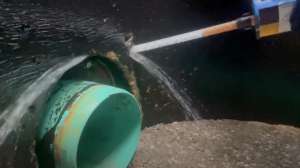
The demanding part is making sure the job is done correctly. Hunter observes that municipal systems are aging. “These are old clay and concrete pipes and they’re getting in pretty bad shape,” he says. “Usually we find tree roots in the pipes, and low spots with grease built up. We clean the pipes and make sure everything is kept running.”
Other major customers are Hill Air Force Base and three area sewer districts. “The Air Force base has its own equipment, but if they have problems, they will call us,” Hunter says. “We also do work for contractors on the base. With the sewer districts, we go in and cut tree roots. I’m on standby if their machines go down.”
Hunter stays in very close contact with the municipalities. “If there is a plug in a city main, I will have a crew there within the hour,” he says. “They don’t even have to buy their own equipment. I take care of the systems even if they have their own and they want me to help them out. Some of this work can be very demanding.”
Not just pipes
As for quality work, Hunter expects the best from his crews. “No matter where my people are working, I want the same high quality,” he says. “My wife watches the tickets as they come in to check for accuracy in billing. Her staff also calls every customer to be sure everything is OK. If it’s not, the technician goes back.”
LaDawn Hunter runs a tight ship at the office, working with four secretaries, controlling the money and delegating the crew for house calls. “People often ask me how I handle my job,” she says. “I’m kind of old fashioned. We have all the computer programs, but I still do some of it the old way. We have problems in the area with power glitches.
“Computers are fine if they’re working, but when you don’t have power and they’re not working, I still want to be able to run my business. We have generators and we can hook up the phones, but that’s not enough to power all the computers. So I back up data the old-fashioned way. My accountant laughs at me and says he is going to get rid of my pencil and paper, and I say it’s not going to happen.”
In the field, Roto-Rooter of Ogden vehicles have to maneuver into tight spaces, such as in irrigation fields and on golf courses. To defrost lines under the floor of a frozen food plant, crews use an Epps Model 4435H13 to deliver water at 200 degrees at 4 gpm.
Hunter chose UEMSI camera trucks and systems in part because the repair shop is nearby in Sacramento, Calif. “We do maintenance once a year on the camera vans in November or December, before the weather turns too bad,” he says. “We take the vans to them and they go over the truck from one end to the other. This saves us from a breakdown right in the middle of the busy season.”
For root control, Hunter makes his own cutters, using blades from UEMSI. “We go through at least 20 motors a year, and it’s cheaper for me to build my own,” he says.
Hunter has built a strong business by sticking to the core principles of fleet maintenance, staff training, and effective management. That approach has helped the company forge solid relationships with a wide variety of customers and create a tradition of service excellence.
Continue reading for free