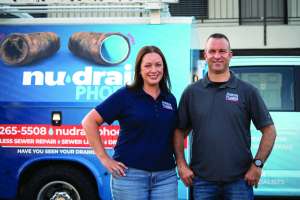
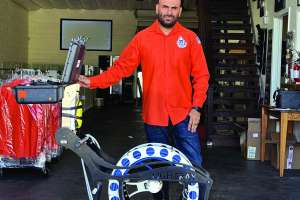
Taking the time to build business relationships also fueled growth, says Marra, whose wife, Ciara, owns the company.
“We put a lot of time and effort into building relationships with companies,” Marra explains. “Earning their trust is key — we make sure we do what we tell customers we’re going to do. It took a while, but our ‘secret sauce’ was time. Everything takes time. It took years to get to know all these different people at all these different companies and build relationships with them.”
Tunnel vision
As a fourth-generation underground infrastructure contractor, working below ground level is in Marra’s blood. His great-grandfather, Angelo Marra, did tunneling work, as did his grandfather, Anthony Marra Sr., and his father, Anthony Marra Jr., owned and operated Marra Constructors, a tunneling and underground infrastructure business.
“I come from a long line of tunnelers,” Marra says. “As a kid, I found tunnels fascinating. I even used to take rides on small locomotives inside some of the tunnels my dad worked on. I thought it was really cool.”
Marra worked for his father for about five years before he and his wife decided to branch out on their own and focus on trenchless sewer rehab, a move his dad supported.
“We thought it was a good opportunity,” he says. “I liked going into the sewers and coming up with different ways to make unique fixes — find ways to make repairs without digging up roads. For whatever reason, I just liked doing it.”
A slow start
The company started out by doing small sewer repair jobs for the Northeast Ohio Regional Sewer District, often patching holes by hand using bagged mortar. Things slowly grew from there through word-of-mouth referrals as the company picked up work as a subcontractor for prime contractors.
“It took a while to build things up from there to where it is now,” Marra says. “It took about five years before people started knowing who we were and it started to get easier to get work.”
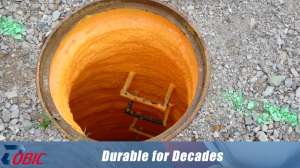
Business picked up even more around 2011 when the company started rehabbing manholes by spraying a cementitious material called shotcrete.
“It seems a little primitive now, but we were limited financially,” Marra explains.
Eventually the company started spray-lining sewers with shotcrete and then got into applying geopolymer coatings, too.
“Spray-lining definitely opened up markets for us,” Marra says. “We got a lot of subcontracting opportunities with companies performing big sewer rehab jobs, with spray-lining just a small part of them. That equipment was a great investment.”
The company’s primary customers now are municipalities and larger underground infrastructure companies that subcontract work out to Marra Services.
“Big and little companies struggle to find workers,” Marra says. “And big tunnel jobs have multiple sites, so it makes sense to sub some of it out so they can focus on other things.”
More work, more equipment
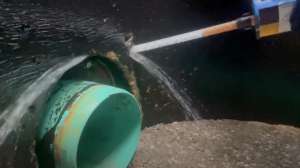
To perform spray-lining, the company relies on pumps made by Putzmeister, Blastcrete Equipment and ChemGrout. The Blastcrete and ChemGrout pumps are used in conjunction with two spray-lining systems from Quadex (a brand owned by Vortex Companies), including a sprayMASTER unit and an I-MARS unit.
When not using concrete, the company typically uses a Quadex product called GeoKrete, a fully structural, corrosion-resistant and mortar-like polymer with strong bonding properties. Polymer linings offer better protection from noxious gases that build up in some sewers, Marra says.
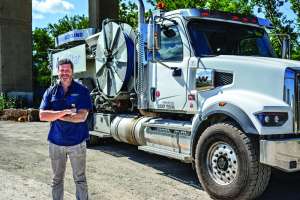
The company also owns an epoxy spray rig from CJ Spray, used with Graco pumps; dewatering pumps made by D&D and Xylem; seven rough-terrain cranes from GROVE (a brand owned by The Manitowoc Co.), Link-Belt Cranes and Broderson Manufacturing Corp.; and Caterpillar excavators and skid-steers, Volvo Construction Equipment loaders and Doosan excavators and a KAISER PREMIER AquaJet water recycler.
Investing in spray-lining systems is expensive. The sprayMASTER system cost about $65,000, Marra says, while the I-MARS system cost around $500,000, which included training expenses and an RMX-5000 mortar-mixing and pumping unit.
Was he nervous about the I-MARS expenditure?
“Sure I was,” he laughs. “But I also was confident we’d be able to put it to work, and you have to take risks as a business owner. That machine has stayed busy and paid for itself in the long run.”
Aside from making the company more attractive to prime contractors who don’t necessarily want to buy such specialized equipment, Marra says the equipment investments also served another purpose: The high cost can make competitors think twice about entering the niche market.
Moreover, because not many companies are similarly equipped, it allows the business to command a premium price for its services, he says.
Slipping into growth
The company’s expansions into spray-lining and then sliplining happened organically, not by design, as customers requested services. Part of the growth stemmed from the fact that many companies don’t like to do confined-space work, Marra notes.
“There’s a lot of risk in what we do, too,” he says. “When things break down and you’re 50 to 100 feet underground, you can find yourself in some real trouble. Or a pop-up rainstorm occurs and all of a sudden you have live sewage flow coming at you.”
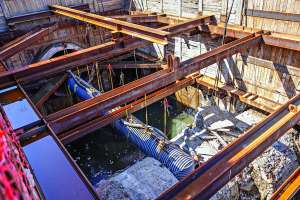
Furthermore, the work can be very difficult. For example, the company is currently sliplining roughly 20,000 feet of an egg-shaped, approximately 54-inch-tall by 40-inch-wide sewer line in Lakewood, a suburb of Cleveland. The clay pipeline is falling apart, making it a poor candidate for spray-lining, Marra explains.
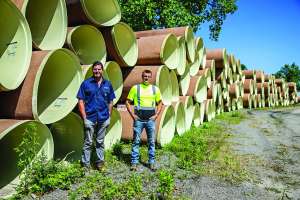
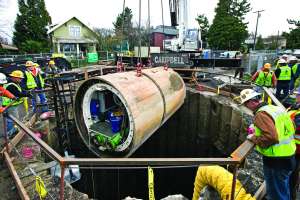
So instead, company crews are using sliplining technology, in which a pipe slightly smaller than a damaged host pipe is installed in sections inside the host pipe, and the annular space around it is filled with grout. Marra Services usually uses fiberglass-reinforced plastic pipe made by Channeline International or HOBAS Pipe USA or HDPE pipe.
“We’re doing the work under flow, which makes the work very challenging,” Marra says. “Plus our guys can’t even stand up inside a pipe that size. They also have to manually push the pipe-carriers, which we fabricate in-house, because you can’t have a diesel engine running inside a pipe that small. Pushing it by hand is very difficult work.”
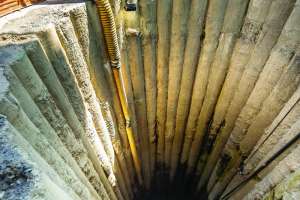
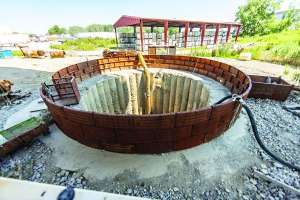
The company is using fiberglass-reinforced pipe from Channeline, which comes in 8-foot sections. Crews can install anywhere from 10 to 25 sections per day, depending on how far away they are from the roughly 12 access pits, which are about 20 feet in diameter and range from 20 to 90 feet deep, Marra says.
The project was started late 2023 and is expected to finish toward the end of 2025, he says.
Sewer solution providers
As Marra looks back at the past 18 years, he says he can’t help but be somewhat amazed at how the company has grown after starting out with only two pickup trucks, an enclosed trailer and five employees, including him and his wife. The company currently employs about 40 people.
“It’s very cool to look back and see what we’ve accomplished,” he says.
About five years ago, the company expanded further by opening a facility in Detroit. As such, the business now primarily serves customers in Michigan and Ohio, Marra says.
“A job came up in Detroit that fit our capabilities,” he explains. “We liked working here and we liked the people, so we kept going. Our workforce is pretty evenly split between Detroit and Cleveland.”
Looking ahead, Marra envisions more growth, but probably without further geographic expansion.
“I’d say we’re definitely in growth mode — hoping to get a bit bigger,” he says. “There’s a lot of work out there. The sewers in Detroit and Cleveland are 100-plus years old, so they’re in constant need of repair. And we’re looking forward to being a part of the solution.”