There are large-diameter pipeline projects in which huge and heavy sections of pipe are wrestled and fitted into place. Then there are confined-space, close-tolerance pipe-laying projects where exactness and precision are paramount engineering concerns.
The Portland Bureau of Environmental Services simultaneously undertook both in 2020. The Oregon city’s $11 million rehab of a 4,000-foot-long section of stormwater line was a test of engineering imagination, administrative expertise and the cooperative spirit of municipal and private sector organizations.
“It was a toughy,” says Don Poletski, construction manager for the Bureau of Environmental Services. “The pipe fought us every step of the way.”
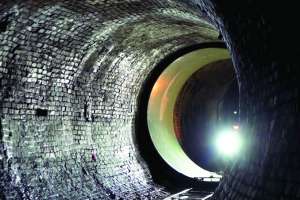
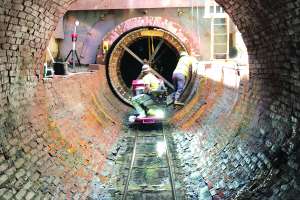
“All the way” constituted about 4,000 feet through a 100-plus-year-old brick tunnel that was less than an inch larger in places than the sliplined pipe, contained several challenging curves and was under a constant flood watch.
The good news: Despite an onslaught of challenges, the undertaking was completed on schedule, under cost and without loss of life. Today, the rehabbed segment of the city’s stormwater system is functioning “exceptionally well,” Poletski says. “We knew if we could get it in there that it would perform really well. And it has.”
Getting lucky
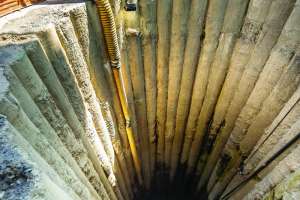
It’s called the Taggart Outfall and is a 6-mile-long section of stormwater pipe constructed of brick over a century ago in a southeast section of Portland. The area was undeveloped in 1908 when construction crews tunneled through it, loosening soil with dynamite and hauling it away with horse-drawn carts. In places, the tunnel resembled a mining shaft a hundred feet deep with an air shaft running down to it to make it breathable.
In this underground space, the original construction crew methodically laid three concentric circles of brick against a wood form, working in groundwater that infiltrated the tunnel constantly. The subterranean storm sewer meandered with the topography and, as it approached its terminus with the Willamette River, almost doubled in size to nearly 10 feet in diameter. The 4,000-foot section most urgently needing repair was in this larger-diameter portion of the pipe.
“A hundred years is a long time,” Poletski notes. “The pipe had heavily deteriorated. It was safe enough to put workers inside it, but it was near the end of its service life.”
Planning to rehabilitate the pipe began in 2014 when the city selected a design consultant, Jacobs Engineering. Over the next half-dozen years, engineering work on the project was split about 50-50 with the bureau’s in-house engineering staff. Fourteen different methods of repairing the pipe were considered by the team. Because the area above the sewer had fully developed in the intervening century — populated with 18,000 homes and 1,500 industrial properties — open trenching was out of the question. One solution — bolting together short sections of curved steel plating inside the brick sewer — was possible, but not a popular option.
“Nobody wanted to do that,” Poletski says. “It was a 20th-century solution and had we chosen that method, we would still be there bolting plates together.”
Furthermore, the thick steel plating would have reduced the diameter of the sewer, lowering the flow capacity of a line already running full at times. Then the project team had some luck. A commercial property that straddled a segment of the pipe and had been scheduled for development unexpectedly became available.
“We were able to use it after all and it totally changed the picture,” Poletski says.
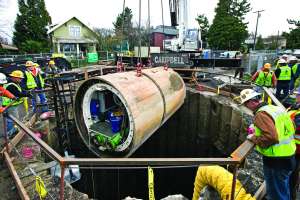
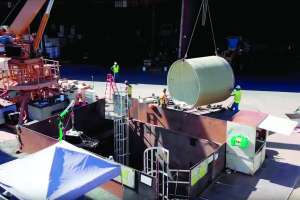
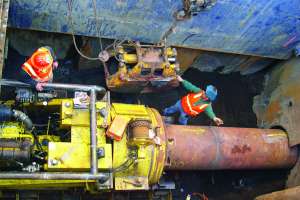
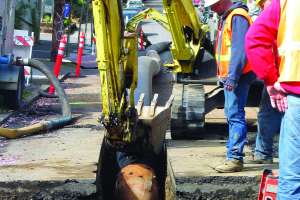
This good fortune let the engineers pursue a first-choice method of repair: sliplining the brick pipe with short sections of fiberglass-reinforced pipe inserted through a hole opened on the property. The low-bid contractor, James W. Fowler Co., acquired a lease on the land and went to work. Removing some 40 feet of soil above the pipe, the contractor exposed the three-ply brick sewer and sawed open the top of it.
But sliplined pipe still raised the same concerns of a reduced flow in the sewer. For 18 months, the issue was researched using flow monitors and computer modeling, a period Poletski recalls with evident exasperation.
Finally, it was determined that, though the diameter of the pipe would be less, the interior surface of the fiberglass-reinforced pipe was slicker than that of the brick face of the old sewer. Consequently, the flow rate would be slightly increased, offsetting the lessened capacity. Reassured, engineers pressed on.
Slow process
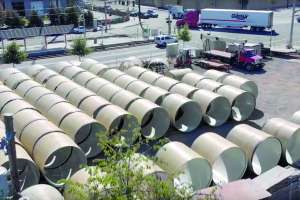
With the old sewer ready to receive the new pipe, things got interesting. The issue was tightness. A $200,000 laser scan of the sewer had determined how long a section of fiberglass-reinforced pipe could be maneuvered through the old brickwork. The answer was an 8-foot-long pipe with an outside diameter of about 108 inches.
To test this premise, a wood mock-up of the pipe was constructed, assembled inside the old brick sewer and winched through the sewer. “Pinch points” were painstakingly navigated, including the curves. The biggest issue was a 270-foot section where brickwork had been reinforced using the aforementioned bolted-together curved steel plating. The internal strengthening was required when an industrial building was constructed in 1959 on the property above the sewer.
Clearance of the mock-up through this steel section was less than an inch. It required the grinding down of the heads of some bolts to allow passage, yet it did pass through, giving a final green light to engineers. A full week was spent moving the first fiberglass-reinforced pipe section through the narrowed area.
How to move the pipe sections through the old sewer then became the problem. The contractor had planned to use a modified telehandler. However, even an expert equipment operator could find it daunting to maneuver a 3-ton, 8-foot-long section of pipe through a tunnel just a few inches larger in diameter without periodically ramming the leading edge of the pipe into the brickwork.
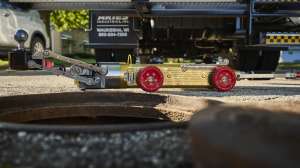
The solution was a locomotive. Specifically, James W. Fowler Co. suggested using a battery-powered mining locomotive that would run unerringly on 2-inch tubular steel tracks bolted and grouted into the bottom of the brick sewer. A LIDAR scan determined exact placement of the tracks to keep the locomotive and sections of pipe centered and away from surrounding brick walls. A month was required just laying the track.
The locomotive solution was especially appealing because this process of transporting pipe sections would have to be replicated 300 times — that’s how many individual sections were to be installed.
“The locomotive gave us a solution that was repeatable,” Poletski says.
A battery-powered locomotive, instead of diesel-powered, was necessary because of the confined space in which it would be operating.
Insertion of the fiberglass-reinforced pipe began with crews working 24/7. It was a slow process. Poletski says 14 sections of pipe were the most installed in any one day. The curves in the line required shorter sections of pipe — the shortest being 3 feet in length — and with different bevels on inside and outside edges.
“It was a tremendous challenge fitting the pipes together,” Poletski says.
Ends of pipe were seated securely using a jacking system. Every 100 feet, grout was inserted between the outside of the sliplined pipe and the old brick sewer, effectively bonding the two structures for extra stability.
Coming together
The project experience was made more intense for everyone by the arrival of COVID just as actual construction began. The immediate impact was limitations on gatherings by engineering staff and some virtual management of team members. The pandemic also sequestered many residents in their homes, which led to more construction noise complaints than usual. But Portland residents were generally supportive of what they came to understand was not a typical utility project.
A wildfire outside Portland also added to the headaches at one point, reducing air quality to dangerous levels. But flooding was the biggest chronic worry. The large-diameter storm sewer served a watershed that was capable of filling the nearly 10-foot-diameter sewer with water within an hour. To reduce the flood danger, the project was scheduled during a relatively dry season in rainy Oregon, with construction crews working 24/7 to get the job done during the season. Weather conditions were constantly monitored and the approach of a summer storm had people scrambling to get out of the pipe.
“One time a random storm came in and we had to evacuate,” Poletski recalls. “We got everyone out of the tunnel eight minutes before it flooded.”
A related aggravation was the occasional illicit dumping of toxic substances into the sewer at night. The pipe always had 3 or 4 inches of flow, which workers got used to having at their feet, but the water would carry the toxic stuff to them. One night an apparent 55-gallon dump of toxic fluid led to an evacuation.
“The most impressive accomplishment was the teamwork we all developed,” Poletski says. “We all wanted the best solution given the constraints. We believed in each other. When you have a team that has bought in, everything is solvable.
“It was really, really important to come up with the best technical solution, one that would give the best service life and so on. We accomplished that despite an incredible amount of adversity. The pandemic. A massive log fire at one point when air quality was bad. We succeeded through teamwork, trust and talent, the three Ts. It’s said you can’t have all that in a low-bid environment. We proved that you can.”