Scott Gayman learned a valuable lesson in entrepreneurship from his grandfather and father that can be summed up in four words: Nothing ventured, nothing gained.
Gayman’s late grandfather, Fred Horne, for example, spent years working with researchers at the University of California-Davis in the late 1960s and early 1970s to develop a product that slows down tree-root growth inside sewers without harming the trees.
In 1979, Gayman’s late father, Richard, left a steady job with a nationally known sewer cleaning company and started Pacific Sewer Maintenance using his father’s root control product. The business, based in Glendale, California, also pioneered the use of water jetters and pipeline inspection cameras in the sewer cleaning industry in the late 1970s and early 1980s.
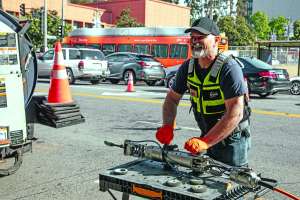
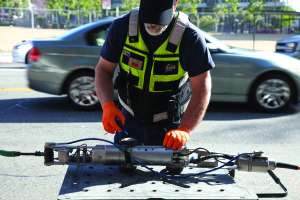
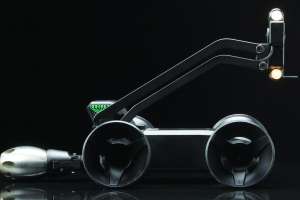
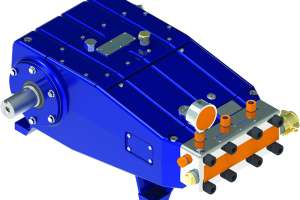
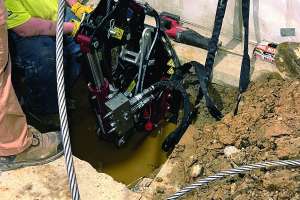
After assuming co-ownership of Pacific Sewer Maintenance around 2008, Gayman himself ripped a page from the family’s entrepreneurial playbook and invested about $140,000 in a robotic cutting machine from Sewer Robotics (a brand owned by ID-TEC in the Netherlands) and an ultra-high-pressure, hydro-blasting pump from High Pressure Pumps (HPP, a brand owned by PTC), thus diversifying Pacific Sewer Maintenance’s services.
“I saw a wide market for the technology,” says Gayman, 57, the company’s CEO. “I’m very pro-robotics, simply because I see it as the next step in maintaining sewer lines. I looked at it as a way to cut out difficult tangles of roots in pipes, which are harder to treat with the foam chemical. We wanted to make sure jobs were done 100% of the time without failure and saw this as a way to make that happen.”
But when he traveled to Europe to get training from Sewer Robotics, Gayman saw his vision was too narrow. He learned that the machine could be used in more applications than he initially envisioned, particularly for removing pipeline obstructions.
“I realized we could solve a lot of the problems municipalities face,” he explains. “They were spending a lot of money digging up [obstructed] pipes when they didn’t have to.”
TECH INVESTMENTS PAY DIVIDENDS
Keeping up with technological investments has been “massively important” to the company’s growth, Gayman says.
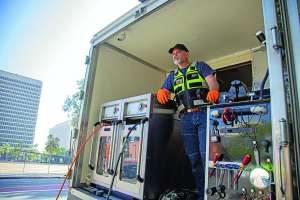
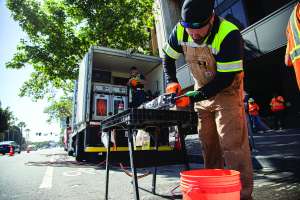
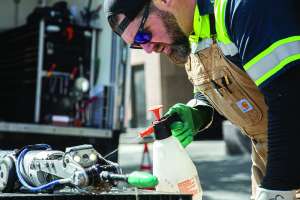
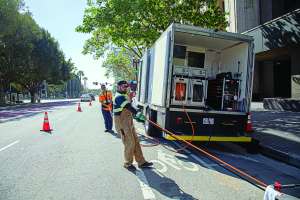
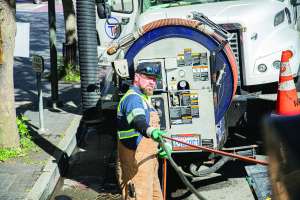
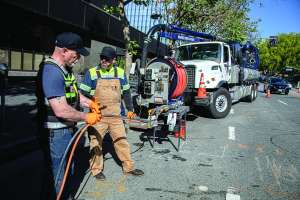
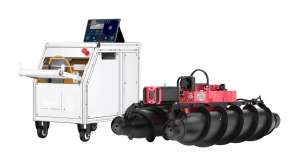
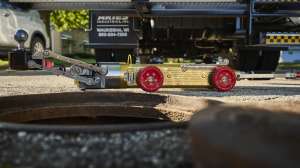
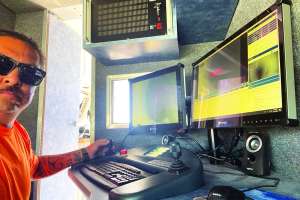
For example, Pacific Sewer Maintenance has purchased a total of four robotic cutting machines from Sewer Robotics: one WJ125 module, carried on an R-125 wheeled crawler, and three WJ180 units mounted on R-160 wheeled crawlers. The company also has invested in three ultra-high-pressure water pumps from HPP (they generate either 15,000 psi at 7 gpm or 40,000 psi at 12 gpm); the pumps supply the water for precision jetting/cutting. (The robotic cutters come with a variety of detachable heads for mechanical cutting and water blasting.)
In short, those investments dramatically improved the company’s fortunes, Gayman says.
For starters, it spurred Gayman to think about how other advanced technologies could make his root control operations — which already were very successful, with more than 50 million feet of sewer lines treated — even more productive and profitable.
“We were a very traditional company before we bought robotic systems,” he says. “We used very traditional equipment. But after we bought the robotic equipment, I realized how I was holding us back by using the same equipment and processes we always had used.”
For example, Gayman started investing in advanced, more efficient pumps and motors for foam-spraying equipment.
“The new pumps, for instance, use less energy and are easier to work on and are more functional in the field,” he says.
Of course, there’s an initial upfront cost for those investments. But they pay dividends down the line by saving the company “considerable amounts of money,” Gayman says.
More advanced pumps in foaming systems that used to cost, say, $5,000 to rebuild or replace now cost about $800 to rebuild, he says.
BRANCHING OUT
Part of this knowledge came from branching out and talking to businesspeople outside the sewer industry — companies that spray pesticides, for instance, Gayman says.
“They told me I was using equipment they used to use in the 1980s,” he says. “I came to the conclusion that these foaming components could be more functional, smaller, more effective [for foaming] and cheaper to run.”
The recession of 2008 and 2009 also played a role in the company’s diversification efforts when about 90% of Pacific Sewer Maintenance’s root control business disappeared in only two months.
“I realized at that point that I was woefully unprepared to deal with that kind of business slow down,” Gayman says. “A singular focus on just one service results in you ending up with nothing during an economic downturn. That’s when we got into robotics. We realized we needed more.”
Root control contracts currently generate about 70% of the company’s revenue while the balance comes from removing pipe obstructions, though the percentages vary year to year, Gayman says.
Because much of the root control work is centered on long-term contracts, it’s a steady revenue generator. For instance, Pacific Sewer Maintenance has been foaming 2.5 million feet of sewer lines in Los Angeles for 11 years.
“Every two years, we return to the same section of pipe we’ve already treated and start over again,” Gayman says. “We’re also fortunate because very few companies do this kind of work.”
DEEP INDUSTRY ROOTS
Pacific Sewer Maintenance likely wouldn’t exist if not for Horne’s inquisitive and innovative nature, which led to his collaboration with UC Davis.
“His big contribution to the process was putting the product into a foam, so users wouldn’t have to flood an entire sewer pipe with massive amounts of a chemical,” Gayman says. “He had no chemistry background, but was just an all-around brilliant guy.”
Horne eventually figured out how to couple an herbicide spray rig with an air compressor, which blew air into the chemical mixture and turned it into foam. He sold the product, which is called Vaporooter, through a business he owned called Arrigation Engineering.
Years later, Gayman entered the sewer cleaning industry by default after working for his father during summers and occasionally on weekends since he was about 15 years old.
“I like to say my dad gave me two options when I came of age — work for him or work for him,” Gayman quips. “College was not in the cards.”
After graduating from high school, Gayman worked for several different employers, but kept going back to Pacific Sewer Maintenance to help his father when needed.
“That eventually morphed into working for him full time,” he says.
At one point in the late 1980s and early 1990s, Gayman spent four years in Egypt as part of a $727 million U.S. Agency for International Development project to improve wastewater collection in three cities along the Nile River. His job: mapping the cities’ sewer systems, he says.
Gayman’s father owned Pacific Sewer Maintenance with his two brothers. The brothers sold their interest in the company to Gayman around 2008.
GROWTH MODE
Looking ahead, Gayman says the company is ready for a growth spurt.
“We’ve been small for a long time,” he says. “It’s time to grow. But we’re going to be very judicious about it. We don’t want to be slapdash about how we grow. Most of our root control work is in Los Angeles, but we’re building a foundation and are ready to expand geographically.”
Gayman’s brother, Todd, who also did root control work, recently retired and Gayman bought his equipment. That positions the company to keep servicing customers in Northern California and Oregon, he says.
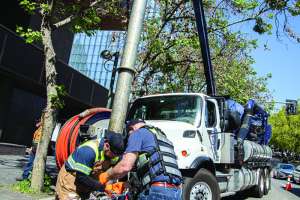
As for robotic cutting, Pacific Sewer Maintenance is building out a second truck and concentrating on educating potential customers through a marketing campaign. Too often, potential customers only think about hydroblasting to remove obstructions, so getting the word out about Pacific Sewer Maintenance’s capabilities is needed to fuel growth.
“People generally don’t think of [robotic jetting] for clearing obstructions in pipelines,” Gayman says. “So we’re working on advertising to educate the industry about this equipment.” In the meantime, the company is relying on strong word-of-mouth recommendations from impressed customers.
“Inspectors come by jobs and watch us work and they all say, ‘This is pretty amazing,’” Gayman says. “So once they find out it’s fast and effective, it becomes more of a regular thing. But getting the word out is the most difficult part.”