The words “fiber conduit” were originally used in the U.S. for a water-resistant composite pipe made of layers of compressed wood pulp and coal tar. Its use began in the late 19th century through about 1970, in applications ranging from water supply and wastewater collection to conduit for telegraph lines, phone lines and electrical service.
Demand for the pipe surged during the building material shortages of the post-World War II market due to the pipe’s relatively long expected service life (up to 50 years) and inexpensive price point. One manufacturer founded to meet demand was based in Orangeburg, South Carolina, giving fiber conduit one of its most widely used nicknames — Orangeburg pipe.
The most recently laid Orangeburg pipe has already been in the ground since about 1970, rendering all extant fiber pipe in use today well past its useful life. The urgent need to replace all the existing fiber pipe is complicated not only by just how widespread its use was during the 20th century, but by how much of that pipe now underlies crowded surface conditions resulting from over a half century of urban sprawl.
THE IDEAL SOLUTION
Minimally invasive, trenchless replacement techniques such as the pipe bursting method provide an ideal solution.
In March, Three Sixty Solutions based in Lost Creek, West Virginia, introduced the state to its new pipe-bursting pipe replacement services. Its initial project was an excellent demonstration of just how effective the technology and technique are, reducing project impact and expense of what otherwise would have been a major construction project into a two-hour job at less than a tenth of the roughly estimated cost.
Three Sixty Solutions’ utilities division specializes in water, sewer and gas lines. It handles some residential work but most projects are commercial, industrial and municipal public services throughout West Virginia. Founder Brandon Hudkins says he had been studying the use of compact, portable pipe bursting systems for four years. The company took on a Shinnston, West Virginia, job that provided no other feasible solutions as its initial pipe bursting project. He consulted with HammerHead Trenchless Technologies for the equipment and training of his crew.
PROJECT DETAILS
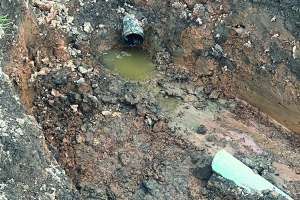
The city of Shinnston needed to replace a 100-foot length of a compromised 4-inch Orangeburg sewer line. The end-user had been experiencing slow drainage for about a year with periodic stoppages and backup. The pipe had now completely collapsed and was broken in places leading to inflow and infiltration problems.
The conventional solution would have been to excavate and extract the failed pipe to replace it with a modern plastic pipe product. But crowded surface conditions left no room for heavy equipment. The house was situated on a slope. Hydroexcavation could be used to expose the pipe. It was about 3 feet below the surface at the street and 11 feet deep at the house, where it entered the basement beneath its cement floor. Space between neighboring structures, however, was only 4 feet. Any excavation posed a risk to the structural integrity of the foundations in such close proximity.
Although the building was surrounded on three sides by other structures, one less risky opencut alternative would have been to reroute the pipes out the opposite side of the basement. However, this would be a major construction project entailing demolition and consequent restoration of much of the home’s basement floor. Trenching the new pipe path would lead it down the block past other residences, turn to follow a side street and return back down the block to connect to the city’s wastewater collections system beneath the road.
“We do that kind of work,” Hudkins says.
But using the pipe bursting method not only meant they would not have to but that they would complete the job in a fraction of the overall project time and cost.
GETTING TO WORK
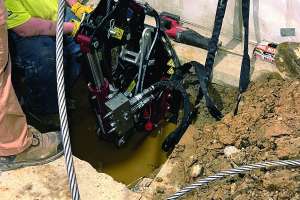
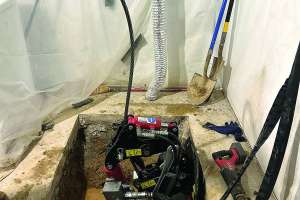
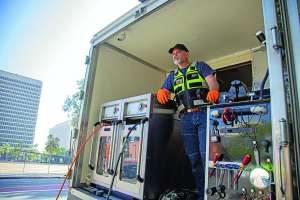
Three Sixty Solutions used a PortaBurst PB30 Gen 2 to do the burst. The PB30 is a compact, modular pipe bursting system providing up to 30 tons of cable-pulling force for in-place replacement of lateral pipes 2 to 6 inches in diameter.
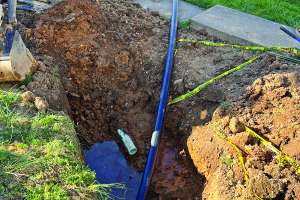
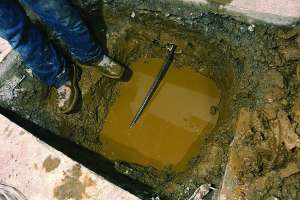
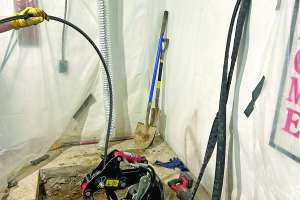
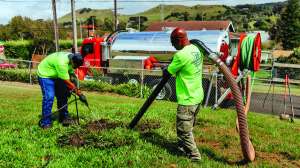
The crew created a 4-by-4-foot entry pit to a depth of 3 feet at the street. Inside the full basement at the pulling end, they cut a similarly sized pit to a depth of 1 foot through the cement floor. It was sufficient room to access the pipe and provide space for the cable pulling unit. No additional excavation was required.
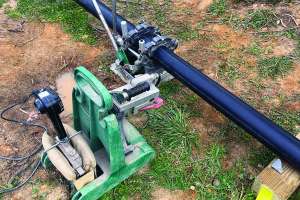
The crew fused up the 100-foot length of 4-inch IPS DR 11 HDPE pipe. Hudkins says DR 11 was “heavier than required for this job” but posed no problem entering the pit despite being a little stiffer than HDPE pipe with thinner walls. Fusing pipe creates a lip inside and outside the joint. The crew removed the lips using a special de-beading tool to eliminate any “speed bumps” and ensure completely unimpeded flow.
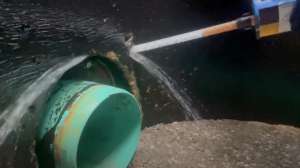
The crew fed the pulling machine’s 3/4-inch-thick cable through the pipe to the entry pit, where they attached the bursting tool assembly. Behind the assembly they attached the HDPE replacement pipe. Then they began pulling the bursting head through the existing pipe back to the pulling machine. As the tooling progressed, it fractured the existing pipe in situ, pressing the fragments into the surrounding soil while slightly enlarging the hole to glide the new pipe into the exact same path as the original lay of pipe. This eliminated the need to extract and dispose of the fiber pipe, which remained in the ground outside the HDPE.
There was no other impact on the surrounding ground behind the pipe path. The two nearby homes over the pipe’s path were completely undisturbed.
Pulling all 100 feet of fused pipe into place — which ran beneath two buildings — took 13 minutes. Service to the end user was disrupted for only two hours, from the time the line was opened until it was reconnected.
Total time on site was two and a half days, which Hudkins says would normally be shorter. In addition to preparation for the job and restoration to complete it, time was taken to educate and cross-train the utility team on the application itself and the proper use, care and maintenance of the equipment.
TRENCHLESS DEMAND
Hudkins anticipated immediate interest for Three Sixty Solutions’ new pipe bursting capability, but the amount of demand was still surprising.
“We got it way quicker than what we expected,” he says.
Observers who had come to the Shinnston job to watch the technique firsthand included representatives from other West Virginia municipalities. Hudkins was booking future jobs while the Shinnston job was still underway. As word of its success has spread, he has steadily received bid requests for more work.
COST COMPARISON
Although the Shinnston job was not bid for opencut replacement, Hudkins gave a rough estimate of what it might have cost the city in comparison. Equipment and labor costs, up to two weeks of project time, extensive excavation plus basement street demolition, and all associated restoration costs could easily have run $85,000 or more.
“We saved them at least $75,000 on this job,” Hudkins says.