Remember Aesop’s Fables, the stories with morals that our parents read to us when we were children? Through these and other tales, we learned the value of an entertaining story that allows us to learn an important lesson.
Such stories still hold power. Every operator has a favorite war story that gets dragged out at the end of the day, or when swapping tales with colleagues. Sure, it’s fun to compare battle scars and to watch friends and co-workers try to win a contest of one-ups-manship. But sharing such anecdotes also serves a useful purpose.
In the school of hard knocks, these stories are educational. After all, it’s much less costly and annoying, and possibly even less frightening, to learn through the trials and tribulations of others than to face all the trouble yourself.
For a dozen years, A-K Underground has been getting customers out of sticky spots in the metro Chicago area. “If it’s pretty much an ugly job that no one else wants to do, that’s when we get called in,” says owner Al Kulig. “It’s what we’re known for.”
The company does a lot of clearing of clogged catch basins and weirs beneath transportation infrastructure. The most complex job Kulig recalls was clearing a debris-choked twin box culvert running for 125 feet under Interstate 90, about 40 minutes outside Chicago. Recent floods had jammed everything from tree branches and old tires to fast-food containers and bottles into both 12-foot-wide, 8-foot-high courses. All that trash was firmly packed in 3 to 5 feet of solid, dried mud.
“We had to divert the water out of one course while we worked on the other,” recalls Greg Kulig, the owner’s son. The crew erected diverters using lumber, plywood, sandbags and a lot of hand shoveling.
Once the water was diverted, A-K crew members got down and dirty into the thick muck with hand shovels and wheel barrows in relentless summer heat. They shoveled as much of the debris as possible into the vacuum truck hose, but the parts that were out of reach required lots of walking.
“We used a pole to judge the depth,” Al Kulig explains, “but underestimated the amount of muck. There was a layer underneath that had been there for years, and it was hard as a rock. Finally, after a month, we got it done.”
Another challenge involved clearing a 40-foot-deep concrete weir at O’Hare Inter-national Airport of a mass of scaffolding that had been encased in several feet of mud by a flash flood from a nearby creek.
“The water had already run out,” says Kulig, “and now we had to dig that stuff out of layers of silt, rock and sand that was beginning to set up almost as hard as the concrete. We parked two vacuum trucks about 30 feet away so we could shovel the dirt up after we broke it all out with a pickax.
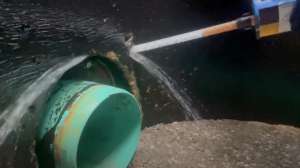
“The last bit we blasted off with a jetter, and we even used squeegees to leave the bottom clean and dry. That was three weeks after we started.”
“Sheer brute force required” seems to be a common element in many cleaners’ war stories, but Frank Brandse knows that sometimes challenges come more in the form of etiquette or politics. In his second year of business, Brandse ran into a restaurant owner who insisted he had been having his grease trap cleaned religiously.
The customer wanted PRO GTS to take over the contract. He didn’t say why, and Brandse didn’t ask. He was enthusiastically building his grease-trap-only business, and here was a new customer who had ongoing work to offer.
“That was a mistake,” Brandse says. “He said he wanted to move to quarterly service, so that’s what we wrote the work order and the quote for. You meet with someone and you agree on a price. They tell you they’ve had regular maintenance done for the last several years, so you shake hands and go out to crack the lid — and it’s solid. You can’t get through it.
“Now, what do you do? Do you go back and call the customer a liar, or do you just do your best? I chose to do the latter. The job, of course, took way more time than I’d estimated, but I stuck with my quote. I did however, tell the owner that he had to up his maintenance routine from quarterly to monthly, at least until we got caught up.”
The moral of the story? “Inspect before you pump,” says Brandse. “Or at least have a disclaimer in your fine print stating that if the size of the job or the condition of the trap is different upon inspection than originally represented, you have the right to alter the quote accordingly.”
Continue reading for free