An 8-inch terra cotta sewer was failing in the Town of Newburgh, N.Y. The mainline ran beneath the middle of Neversink Drive in a dense subdivision.
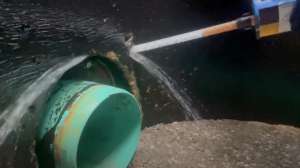
Flow problems alerted the Depart-ment of Public Works, but blockages prevented a camera from televising the entire line. The inspection did reveal cracks and holes in the top of the pipe, and root intrusion. Boulders 18 inches in diameter protruded into the line, and joint separations created high and low offsets.
Fearing the main’s catastrophic collapse, James W. Osborne, P.E., town engineer, hired Stearns and Wheeler LLC, an engineering firm in Middle-town, Conn., to develop separate excavation and pipe-bursting plans to replace the line. Only the excavation plan was put out to bid, as no one expected pipe bursting to work against the boulders and hard glacial till packed with rocks of every size.
Whispering Pines Development Corp., a large municipal contractor in Newburgh, won the contract. John Leonette Jr. and a contractor decided to try an alternative approach to the project: an untried new static puller.
Leonette presented the proposal to Osborne, who suggested a 300-foot trial run. Osborne also activated Stearns and Wheeler’s pipe-bursting plan, which called for potholing service laterals. The combination replaced the failing main without disrupting homeowners or the handicapped occupants of group homes on the street.
Minimizing impact
A 24-inch concrete storm drain lay over the top of the sewer. If Leonette had to excavate, the drain would require support, or removal and replacement, all at additional expense. Open cutting would close the street to traffic for three weeks, yet the group homes needed 24-hour access.
The department and Leonette had never done pipe bursting before. “I got on the Internet, researched the subject, and contacted Todd Carter at TRIC Tools,” says Leonette. “He and his brother, Ward, came to assist and supervise in the use of the new WC44 low-pressure static puller.”
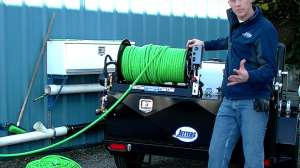
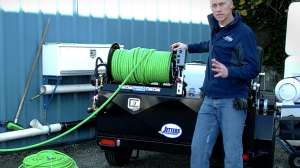
Leonette hired two hydroexcavation trucks from Hydrovac Excavating Inc. in New Windsor, N.Y., to locate and pothole the six laterals on the 300-foot test run. The trucks, built by Presvac Systems, had 14-cubic-yard debris tanks, 1,200-gallon water tanks, 5,300 cfm/15 inches Hg Hibon blowers, and 9-gpm/ 5,800-psi water systems.
“One traffic lane remained open even when the machines were operating in the road, and the sidewalks were never closed,” says Leonette. “At night, the 4- by 4-foot potholes were covered with steel plates and the work area cleaned up. We had no dirt piled on the street, and Neversink Drive was open every night.”
As laterals were potholed, Leonette’s men excavated an 8- by 2-foot entry trench in front of the first manhole and a 4- by 3-foot exit (pull) pit behind the second manhole 300 feet away. They jack-hammered the old concrete-encased manholes to create openings for the pulling head.
On Tuesday, Leonette’s crew fused two sections of four, 40-foot lengths of 8-inch HDPE SDR-17 Drisco pipe on the curbside. The Carter brothers set up the aluminum resistant plate in the exit pit and laid 6- by 6-inch timbers in front of the plate to create a level head wall for the WC44 static puller.
The WC44, from TRIC Tools in Alameda, Calif., is a high performance, high-flow puller for the municipal market. Designed to use with an onsite hydraulic power source, the 39.27-square-inch tool runs 1-, 1 1/8-, and 1 1/4-inch cable and can static burst up to 16-inch pipes. A compact radius tri-wheel pulley base reduces mass and footprint in the pulling pit. The low-pressure machine can deliver 126 tons at 6,200 psi.
Round hole, wrong diameter
As Osborne and town officials watched, Ward Carter began the first pull. The pressure gauge hovered between 28 and 32 tons until the bursting head encountered a boulder or dense obstruction. The pressure then rose to 50 tons, but that was well within the 1-inch cable’s limit of 64-tons, which is adequate for 8-inch pipe.
“Per cubic foot, concrete has a density of 95 and glacial till is 98,” says Carter. “In hindsight, we should have selected the next cable size, but this was my first till encounter using a tool designed for California’s conditions and climate.”
The only problem arose as the bursting head approached the exit manhole. “We didn’t make the hole in the concrete structure big enough and that stopped the head,” says Leonette. His men quickly excavated a 2- by 2-foot hole and jack- hammered more of the concrete. The head then popped through into the manhole.
The pull took almost a day as everyone became acquainted with the equipment. “It was an impressive demonstration of the static puller’s capabilities,” says Leonette. “The new machine performed flawlessly.”
Osborne did a visual inspection and announced that all had gone well. He said the storm drain didn’t have to be removed, and gave permission to replace the remaining pipe the next morning. Leonette’s crew had a long night reinstating the six 4-inch laterals. After cutting through the mainline wall, they used Inserta Tee, a PVC hub, rubber sleeve, and stainless-steel band from Inserta Fittings Co., Hillsboro, Ore. to reconnect the services. “The pull was easy compared to hooking up those laterals,” says Leonette.
Second pull
The second pull involved excavating a 4- by 3-foot exit pit behind the third manhole, 440 feet upstream from the middle one. Once everything was set up, the pull took 90 minutes. After his men reinstated 11 laterals, Leonette used a P330 Flexiprobe push camera from Pearpoint Inc. to inspect the 740 feet of replaced pipe. Finding no flaws, the crew backfilled the insertion and pull pit openings and lateral potholes to within four inches of grade.
The men saw-cut the asphalt at each hole to leave clean edges, then blacktopped them. Where laterals were close to the curb, or where the hydroexcavation trucks had driven on the grass, they spread topsoil, raked, seeded, and topped with hay.
“The trenchless solution took five days compared with three weeks to open cut, and vehicular and pedestrian traffic never stopped flowing,” says Leonette. The town has since awarded Whispering Pines a 170-foot pipe-bursting project.
Continue reading for free