
Almost every job is difficult when it comes to spray-lining or sliplining aging sewer lines.
But even after rehabbing tens of thousands of feet of sewer lines using these techniques over the years, it’s still easy for Nick Marra, vice president of Marra Services, to pick out the most challenging job the company has ever tackled: sliplining a large-diameter, roughly 1,900-foot-long sanitary sewer interceptor line in Detroit.
“We sliplined a 17-1/2-foot-diameter sanitary concrete pipe that was deteriorating from gas fumes,” he says. “The 16-1/2-foot-diameter pipes we used for sliplining were the largest-diameter pipe we’re ever worked with. It was a very difficult job — easily our most challenging project, without a doubt.”
In addition, the utility that owns the sewer, the Oakland-Macomb Interceptor Drain Drainage District, wanted to use three different kinds of 16-1/2-foot-diameter, bell-and-spigot pipe for the roughly $16 million project. They want to see which one performs better over time: fiberglass-reinforced plastic pipe from Channeline International, precast polymer cement pipe from P3 Polymers or carbon-fiber pipe from QuakeWrap.
Channeline pipe manufactured in 7-foot-long sections was used for most of the sliplining — about 1,600 feet. The rest of the pipe was lined with about 180 feet of 6-1/2-foot-long sections of RockHardscp pipe and around 180 feet of 14-foot-long sections of QuakeWrap pipe, Marra says.
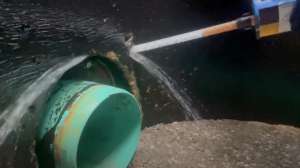
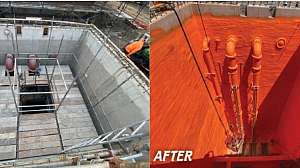
Work crews left about 3 feet of space between the end of one kind of pipe and the start of another kind of pipe, then used a spray-lining system from Quadex (owned by Vortex Companies) to seal those transition areas with GeoKrete, a Quadex polymer coating.
“The sewer line had curves in it, too, so Channeline had to custom-make angled pipe sections so it would fit in the curves,” Marra says.
In addition, work crews had to excavate a roughly 35-foot-diameter and approximately 50-foot-deep access shaft, remove the top of sewer line, clean the pipe, make spot repairs before installing the liners and then fill the annular space between the new pipe and the host pipe with a nonstructural, lightweight grout.
It took about two years to repair the section of sewer line, which is part of the sprawling Oakland-Macomb interceptor system. It consists of roughly 42 miles of sanitary sewer lines that serve about 850,000 residents in 25 municipalities in Oakland and Macomb counties. Officials decided to use sliplining because the flow of sewage in the line could be shut off only temporarily for portions of a day.
“We’ve done a lot of sliplining and grouting before, but just not this size or scale,” Marra says. “We enjoyed the challenge, for sure.”
Read more about Marra Services in the October 2024 issue of Cleaner magazine.
Continue reading for free