
Many contractors talk of seeking efficiency. Actually executing that vision is another matter.
But Seattle’s Brewer Sewer is indeed that epitome of efficiency. Owner Travis Brewer has applied it to the company’s pipe lining operations in the form of a custom-built truck equipped to remove all the excess fat on setup and cleanup time surrounding a job.
“When the truck pulls up, as soon as the door opens we’re ready to roll,” Brewer says. “I had efficiency in mind. That was a huge driver in this. We wanted to solve the big problem we saw in residential lining of setup just taking so long.”
It’s an example of the approach Brewer has taken throughout his business. Always thinking about forward progress, a better way of doing things. Not satisfied with the status quo. And all in service to a straightforward goal.
“The long-term plan is just to build and scale a successful trenchless company from Seattle to Tacoma,” Brewer says.
Opportunity knocks
Originally from Kodiak, Alaska, Brewer’s family moved to the Seattle area when he was a teenager. He got his start in the wastewater industry in his early 20s working in the field for other companies, doing mainline water and sewer work.
After about eight years being an employee, Brewer decided to branch out on his own and started Brewer Sewer in 2019.
“I saw opportunity,” Brewer says. “I was working with a guy who offered pipe bursting. He was a small operation and didn’t want to grow, to be anything more than just a couple-man shop. So I started Brewer Sewer.”
The company began with a focus on excavation work and pipe bursting. Lining work was subcontracted out initially before eventually being brought in-house.

“The first four years, we had slow, steady growth with just a small crew of about five,” Brewer says. “It’s only in these past two or three years that we’ve invested heavily into trenchless — equipment and training. For 2025, our sales were up a little over 40% from the previous year. I think a lot of that can be attributed to efficiency and just speeding up the whole lining process.”
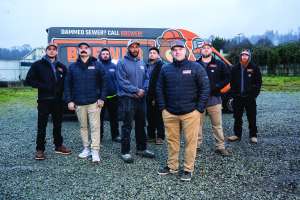
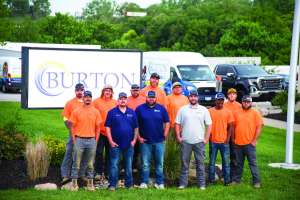
Brewer Sewer has also started investing more in its marketing and branding. The company recently hired its 12th employee. While it still does offer pipe bursting, lining has become Brewer Sewer’s predominant service. It makes up about 50% of Brewer Sewer’s revenue. The rest comes from drain cleaning, jetting, inspection, excavation and pipe bursting.
“We’re growing fast now,” Brewer says. “We want our brand to be positioned as the go-to trenchless solution in Seattle.”
A better way
When Brewer Sewer first got into pipe lining, its primary experience to fall back on was through observing the company it had been subcontracting lining work out to.
“We saw how they ran their operation,” Brewer says.
But he quickly realized that there was a lot more efficiency to gain. He noticed how so many lining setups required considerable time on the front end unloading equipment just to be able to get to the actual lining of the pipe. Not to mention the reverse at the end of a job — cleanup and reloading everything back onto the trailer or truck.
“Our first truck was similar,” Brewer says. “We had to roll everything out, and I just saw so much room for improvement and efficiency. We see guys still to this day having to unload entire trailers with all these hoses, their air dryers, their compressor on wheels. We wanted to bring efficiency to a lining truck.”
About three years ago, Brewer Sewer started developing ideas for the design of such a truck.
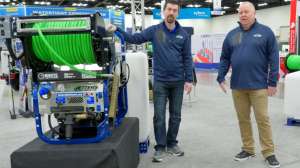
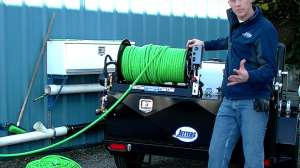
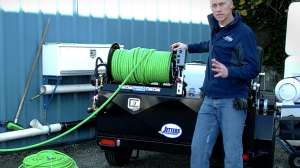
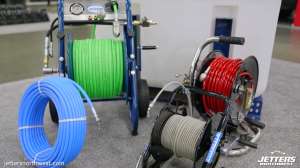
“I had the idea that if you put everything on hose reels, you could literally just open a roll-up door, push a button to fire up the generator and be ready to go,” Brewer says.
In mid-2025, the truck made its debut and Brewer says it has worked just as envisioned, reducing the time-consuming setup and breakdown time on lining jobs so that his crew can shoot as many as four liners a day instead of only one.
“I’m pretty sure we’re one of the only ones in the country with a setup like this,” Brewer says. “This truck can drive to any residential area and do any lining, descaling, robotic reinstating, jetting — it can do all this in one truck.

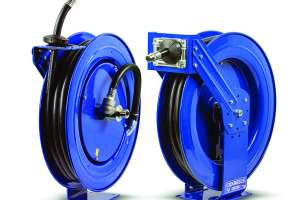
“Everything pulls right off the side. Every hose is on reels. They’re all electric, retractable. You push one button and it pulls all the hose back in. The jetter is undermounted beneath the truck with controls on the outside. There are no coiled-up extension cords inside, no coiled-up air hoses. Nothing has to come off this truck to shoot a liner or to hydrojet. You don’t have all this clutter all over the homeowner’s lawn. We don’t unload anything. We just pull hose off the truck. Because of that, our setup time drops drastically. It’s minutes, not hours. It’s less labor for the guys. Obviously faster turnaround means more jobs.
“We built the truck because disorganization was slowing production. We wanted one truck that could handle everything. Carry material, all the curing equipment, reinstatement tooling and power and water to everything.”
Streamlining
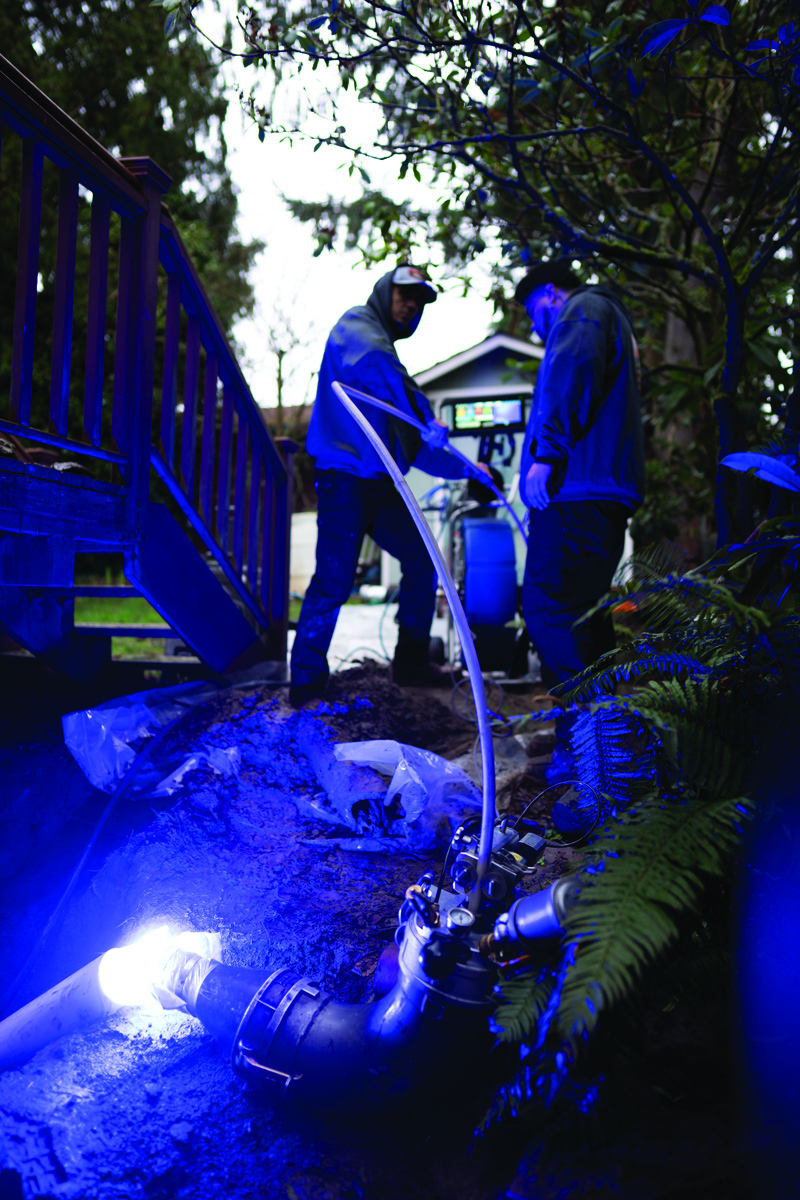
Brewer Sewer runs HammerHead Trenchless’ Bluelight CIPP system out of the truck.
“We bought that about a year ago, and it has brought a ton of efficiency to us,” Brewer says. “We also use HammerHead’s consumables.”

A Vanair air compressor is hard mounted on the truck. Hose reels are made by Reelcraft Industries. A wet-out table is hard mounted in the truck. With the Bluelight system, liner has to be wetted out inside, away from sunlight. Interior cabinetry is made by Cabinets by Hayley out of Canada. Shelving was custom fabricated from local metal shops. A JETTERS NORTHWEST Brute jetter was welded onto a skid and mounted under the truck. An Isuzu NPR truck was chosen for its ability to navigate tight quarters, ideal for Brewer Sewer’s Seattle service area.
“In Seattle, parking is challenging in a lot of these residential areas, so a trailer would’ve been difficult,” Brewer says. “It was not an option for us. If we towed a trailer, we would literally have to get a permit for every lining job just to put up a ‘No Parking’ sign. With this truck being made in Japan, it’s for tight quarters, a small street. We definitely utilize that ability.
“Those rollup doors go up and we have access to all air, power and water. The guys go out and get a measurement with a camera, then cut the liner. This truck even has air conditioning in it. They can run A/C while wetting out liners inside the truck. Then we take the inverter, roll that out of the truck. Unroll our air hose off the hose reel. Invert our liners. The Bluelight curing is fired up with power off the truck. We can usually be in and out anywhere from 1 to 3 hours.”
That’s a far cry from the all-day process it used to take Brewer Sewer to shoot a single liner, back when it had all its equipment just piled into the back of a truck and was employing a hot water curing process.

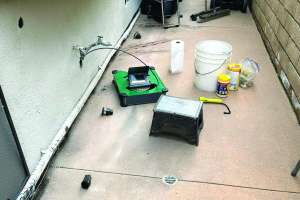
“We’d have to unload everything, get everything set up. We had hoses scattered, power cords scattered all over people’s yards,” Brewer says. “And because we would have to cure with hot water and cool off with cold water, that whole process by itself would be four or five hours. Then obviously unloading the truck would take an hour and loading everything back into the truck, and when we’d get back to the shop we’d have to spend an hour just cleaning up the truck. We’d get one liner a day, but it was tough to get two. Now, at the end of the day, you’re taking out a couple bags of garbage and wiping down the cabinets, but that’s about it.”
The truck goes out daily with a crew of two doing as many as four liners a day. Brewer says the truck is running so efficiently that he believes the one crew can handle even more work than it’s doing right now. In time, when the need is there, Brewer sees building out another lining truck primed for efficiency.
“This is our template,” Brewer says. “We can clone this truck for additional lining crews. We just don’t know when yet. We don’t know when it will be needed.
“This truck has the potential to go out and do $2-4 million of work in a year and with the margins it produces, I can’t believe people don’t invest in building more efficient trucks. Some people are still rolling equipment out of the back of a van.”
A good teammate
In addition to significant investments in equipment, Brewer has also been focused in recent years on investing in his people.
“We’re to the point now where we’re looking for unicorn technicians. These guys are hard to find,” Brewer says. “So we’re looking at building internal talent. Investing more in people and training. I noticed that growth really kicked in when we started investing in our guys and not just our equipment.”

Every Wednesday, Brewer Sewer does a two-hour morning training.
“I’m building a company, but I’m also working on building teammates. In order to do that, I need to be the best teammate,” Brewer says. “It’s a lot of hands-on training. Shooting liners at the shop, going over jetting protocols. Just going over processes. It varies week to week.”
Brewer leads the training himself rather than seeking third-party assistance. Outside trainings are something he says he’d be interested in for the future, but right now the company is still a size where he’s capable of handling it.
“Especially with me coming from the field,” Brewer says. “I wasn’t in sales, I wasn’t a manager. I was a tech. I have a lot of knowledge. I was one of the top sewer guys in our area. No question companies wanted to hire me. So now a part of my job is to teach my guys what I know.”
Besides training, Brewer says he also wants to be sure that he’s taking care of his employees in other ways, like providing them the best in equipment and tools.
“One of my problems when I was an employee was that having bad equipment was miserable. That’s one thing that bothered me the most,” Brewer says. “I’ve sought to solve that for my guys. It’s important for me to have clean vans, top-of-the-line equipment. My guys don’t go without anything. If they need something, we’re going to take care of it.”
It’s for attracting new talent as well.
“That’s just what is required,” Brewer says. “Top talent is not going to some company that stores all their lining stuff on the back of a Chevy Express van. Our lining truck is still fairly new. When guys see us around town, they’re starting to notice us. Why wouldn’t you want to step out of a crummy van and work out of this half-million-dollar truck?”
Continue reading for free