

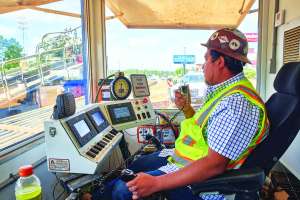
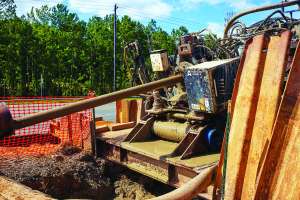
Safety is always a chief concern with horizontal directional drilling. To enhance employee training and mitigate safety risks, Georgia’s Southeast Connections has adopted a new technology: virtual-reality goggles developed by Vermeer.
The goggles do for HDD operators what flight simulators do for airline pilots: provide a real-life, highly detailed virtual experience that allows operators to learn about things such as basic drill functions, bore planning, mud-mixing and steering functions.
And they do so without the risks usually associated with using actual machines for training, says Doug Simmons, general manager of the company’s HDD division, based in Conyers, Georgia.
In 1996, Southeast Connections — then called Southeast Communications — employed one work crew. It owned only a mini-excavator, a trencher and a bucket truck. And it focused solely on installing fiber-optic lines for telecommunications companies, primarily around Atlanta.
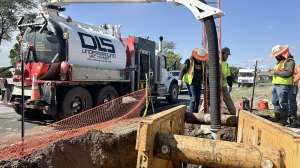
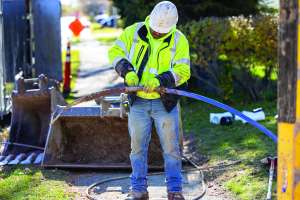
In the ensuing three decades, things have changed dramatically. Today, the company employs about 1,600 people. It serves a variety of utility customers, primarily doing horizontal directional drilling for natural gas pipeline installations. In addition to its headquarters in Conyers, Georgia, the company also has satellite facilities in nine states. It owns nearly $50 million worth of equipment, including HDD machines, hydroexcavation trucks, camera trucks, excavators and a variety of other “yellow iron” equipment.
A sharp focus on employee development and retention is among the key ingredients to the company’s growth spurt, explains Simmons.
“The primary driver of our success is our people,” says Simmons, who joined the company in 2003. “At the end of the day, the guys out in the field with boots on the ground are the ones in front of customers, so the best drivers for growth and success is having the right people in the right places. And when you get them in your network, you have to take care of them in order to keep them. They’re going to be the backbone of the business and the ones that grow the business.
“We might initially invest $6,000 to $7,000 to train someone, so it’s important to show them the way up the company ladder or you risk having them leave. If you don’t respond to their needs and support them, they’ll go somewhere else. So we’re very attentive to providing what they need. We hire more than a dozen people a month, and one common theme I hear from them is they didn’t have much support at their previous job and didn’t get what they needed out in the field. We don’t let things like that fall on deaf ears — we give them what they need, whether it’s technical support or equipment.”
That support includes the training component. Because there’s no formal training for things such as operating an HDD machine, employees mostly receive on-the-job training, particularly from seasoned industry veterans. The company recently created an in-house, one-week-long HDD training curriculum called SEC HDD Academy, Simmons says.
And also part of that training is taking advantage of available technology, like the Vermeer virtual-reality training system.
“You just put on goggles and it simulates you sitting on a machine and operating it out in the field,” Simmons says.
Vermeer also provides initial training on how to operate the simulator so company instructors can conduct on-site training.
For example, one module simulates an operator working on a neighborhood street and moving drilling rods into the ground. The operator can toggle back and forth between doing a bore and checking a drilling plan to orient himself, Simmons says.
“You can even simulate loading and unloading roads, too,” he says. “It gives them good motor skills to remember exactly what the steps are for loading and unloading drill pipe.”
The virtual reality training, which can last for several days, is just one component of the company’s SEC HDD Academy. It’s essentially a training school where field workers who have been with the company for six months or a year get trained to move into an operator or foreman role on the HDD side of business, Simmons says.
The curriculum is about a week long and covers things such as equipment maintenance, bore planning, locator training and so forth.
“It’s basically all-around training that covers everything employees might encounter out in the field,” Simmons says.
To improve boring skills, for example, part of the training centers on a buried 6-inch-diameter, 400-foot-long medium-density polyethylene pipe. While one trainee practices running rods and a drill head through the pipe, another trainee practices pipe-location skills using a Digitrak Falcon F5 pipeline-locating system from Digital Control, Simmons says.
“Allowing two people to work simultaneously allows us to maximize our training,” he says.
The company started using the Vermeer simulator in 2024. Vermeer estimates each employee needs four to five hours of training and Simmons says employees give it a big thumbs-up. It prepares them well for the actual experience in the field. The company’s fleet of more than 80 HDD machines is composed primarily of units from Vermeer. The rest of the fleet is rounded off by machines from Ditch Witch (a brand owned by The Toro Company) and American Augers.
“It’s definitely an eye-opener for them,” Simmons says. “It helps them develop their motor skills and learn some key things they can’t afford to overlook out in the field. It’s like getting paid to learn how to run a machine by playing a video game.”
Continue reading for free