
It doesn’t happen often, but municipalities and contractors sometimes confront severe obstructions that even the highest pressure nozzles can’t cut through. That’s where SewerProShop’s milling cutter options come into play.
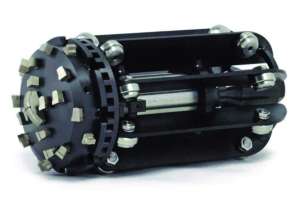
Generally, milling cutters are capable of removing the toughest obstructions where other sewer cleaning equipment fails, such as tuberculation from cast iron pipes, mineral deposits, concrete, calcified grease and collapsed liners.
SewerProShop’s milling cutters, which have been precision-engineered and manufactured by Buehler for over 40 years and upgraded by Intersewer in Germany since 2015, are distributed and maintained by SewerProShop to municipal and industrial markets in the U.S. According to Reinhart Laimer, president of SewerProShop, the cutters have effectively gotten hundreds of clients out of clogged pipe pickles for years.
“I’ve performed countless successful demos since 1997, removing tuberculation, pumice, concrete, mineral deposits, calcified grease and failed liners from sewer lines without damaging even clay or plastic pipes,” Laimer says. “The stainless steel drives of the Intersewer milling cutters aren’t operated by percussion but uniform forward propulsion.”
According to Laimer, to avoid pipe damage, it is important that the right-sized milling cutter is chosen before starting a job. Cutters are available for 4-, 6-, 8-, 10-, 12-, 15-, 18- and 20-inch sizes.
“Experience is always helpful when working with such a sophisticated tool,” Laimer says. “To successfully operate milling cutters, you need to have 60 to 80 gpm at 2,000 psi available. They also have to be completely inserted into the sewer pipe before you start the job. Never slam the high-performance tool against the obstruction. Instead, let the milling cutter do the work. It’s also very important to remember that milling cutters can only be operated in straight pipes, not elbows.”
The stainless steel milling cutter drives with double-sealed, high-speed bearings that don’t need lubrication, ensuring years of low maintenance. They can be operated with recycled water as well. The tough carbide bits are bonded onto stainless steel bodies, with the center bit water cooled. The 6- and 8-inch milling cutters can easily be converted to barrel cutters to cut protruding laterals.
“Cleaning sewer pipes with milling cutters is about evaluating each situation,” Laimer says. “It is definitely more cost-effective to remove severe obstructions using milling cutters compared to replacing entire pipes.” 877-864-9394; www.sewerproshop.com
Continue reading for free