Missouri Septic Pumper Evolves Into Full-Service Wastewater Operation
Diversification alongside high-quality service and equipment investment have positioned Austin’s Pumping Service as a go-to wastewater contractor in Missouri
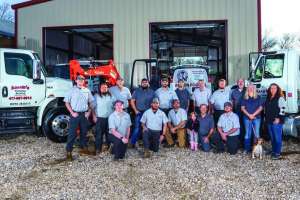
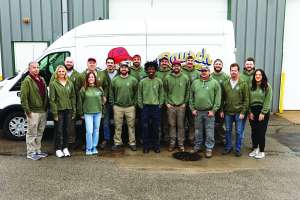
The Austin’s Pumping Service crew includes, from left, (front row) Austin Harris, Carl Warner, Jason Cooper, Amelia Crow, Jack Crow and Jeffrey Beasley; (back row) Jacob Walker, Braxton Shelburn, Garth Villa, Chad Hurrelbrink, Austin Hurrelbrink, Tristan Crow, Mark Dever, Connor Johnson, Douglas Hurrelbrink, Elizabeth Hurrelbrink and Laura Crow.
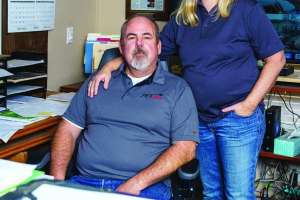
Austin’s Pumping Service owner Douglas Hurrelbrink and his wife, Elizabeth, in the office at the company shop. (Photography by Denny Medley)
Diversification can be the key to long-term success, and Douglas Hurrelbrink has embraced that philosophy with Austin’s Pumping Service, based in Strafford, Missouri.
What started as a straightforward septic pumping business has evolved into a full-service wastewater and plumbing operation with a focus on grease trap maintenance, hydrojetting and real estate inspections.
By strengthening ties with his brother-in-law’s company, Action Rooter Sewer and Drain LLC, Hurrelbrink has created a seamless network of services that keep both residential and commercial plumbing systems running smoothly.
His approach — pairing high-quality service with strategic pricing and investment in top-tier equipment — has positioned Austin’s Pumping Service as a key player in the region’s plumbing and wastewater sector.
Hurrelbrink was a field engineer in California who started the company in 2010, following encouragement by brother-in-law Jack Crow, who had already established his plumbing and drain cleaning business in 2005 in Strafford.
“I told him there was money to be made pumping fluids from one hole and dumping them in another one,” Crow says.
Today, the companies maintain their identities but have merged under a single corporation, Black Water Holding Group, which employs 17 people, about half of the workers on the pumping side.
Austin’s Pumping also once offered portable restroom rentals, but it dropped that service in 2022 to focus on septic pumping and commercial work, with an emphasis on grease trap service, restaurant hydrojetting, and real estate septic and water well inspections.
“Portable restroom work is very labor-intensive and we found it difficult to hire enough manpower,” Hurrelbrink says. “We sold the units, in some cases to our customers, and in many instances we continue to pump them.”
Austin’s Pumping has never seen a shortage of commercial work. Even through the COVID-19 pandemic, the company became busier, pumping for fast food restaurants offering takeout and delivery, where business was thriving.
“Our problem was not being able to purchase trucks fast enough,” Hurrelbrink says. “We’ve taken on contracts with chain companies such as Domino’s and Pizza Hut, and we travel just across the border to Arkansas and Kansas to pursue some of that work.”
In addition, during the pandemic, housebound workers became more aware of their septic systems and began to schedule more regular pumping and maintenance.
Along with pumping, 5 to 7% of the company’s work involves full installation of septic systems, although Austin’s Pumping sometimes partners with local installers, depending on workload.
Septic pumping also opens the door to system repairs and replacement. Many older rural homes have noncompliant systems that range from septic tanks that have no apparent access ports to tanks made out of wood.
Austin’s Pumping has also taken a more assertive approach to pricing, an evolution from the earlier days when it was just trying to establish a presence in the market.
“When we started, we took everything that came our way,” Hurrelbrink recalls. “Half the money would go to fueling the truck and the other half would pay the light bill. We’ve learned that the quality of our service enables us to charge more. If a company is not prepared, it might take them two hours to complete a job. If you show up for the dance well prepared with knowledge and equipment, it might only take 15 minutes. That doesn’t mean you should charge less.”
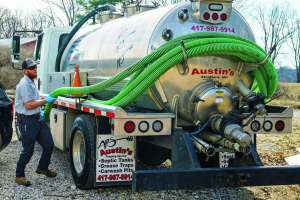
The company’s growing equipment fleet includes four vacuum trucks, all Internationals with aluminum tanks and Jurop RV360 pumps. Hurrelbrink says he prefers the aluminum tanks, saying they are priced competitively with steel and offer a lighter load.
“Every little bit of weight that you can take off the truck reduces wear on your tires, your springs, your shocks, your tie rods,” he says. “The heavier the truck, the more maintenance you’re going to have and the higher your fuel bills.”
He’s stuck with Jurop RV360 pumps because he says they perform well, are easily rebuildable and reduce the hassle of learning to operate and maintain different pumps on each truck.
Equipment roll call
Three of the trucks are built out by KeeVac Industries: a 2011 with a 2,000-gallon Progress tank; a 2019 with a 2,000-gallon tank and 90-gallon freshwater saddle tank for job site cleanups; and a 2022 with a 2,500-gallon tank and 90-gallon freshwater saddle tank. A 2014 built out by FlowMark features a 1,400-gallon waste/300-gallon freshwater tank.
Each truck is equipped with a Gorlitz Go 50 drain cleaning machine and a range of Gorlitz drain cleaning machines for sewer lines sized 1 to 8 inches in diameter. They also carry a range of RIDGID SeeSnake inspection cameras.
Customized toolboxes are a must-have for each new truck order.
“Every truck we build, we try to outfit it with as many toolboxes as it will hold,” Hurrelbrink says. “If there’s a space on that truck, we’re going to put a toolbox on it because we carry an ever-expanding range of tools from cameras and drain machines to jetters and an array of hand tools.”
Hurrelbrink prefers to buy trucks and other heavy equipment new.
“Our very first pumper truck was used and it almost bankrupted us,” Hurrelbrink recalls. “These trucks are run very, very hard, so we like to start with new equipment.”
Service support vehicles include a 2015 Ford F-250 equipped with a service crane for lifting septic tank lids and installing sewage pumps, a 2001 Dodge 5500 4x4 flatbed used to tow a Kubota L39 backhoe and a dump trailer, and a 2010 Nissan 4x4 used for septic system inspections. A shared pool of service vehicles includes a 2012 Dodge 2500 4x4, a 2015 Ford F-150 4x4, and five trucks and vans, including Chevrolet, GMC and Ford.
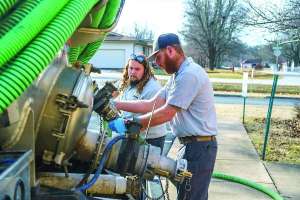
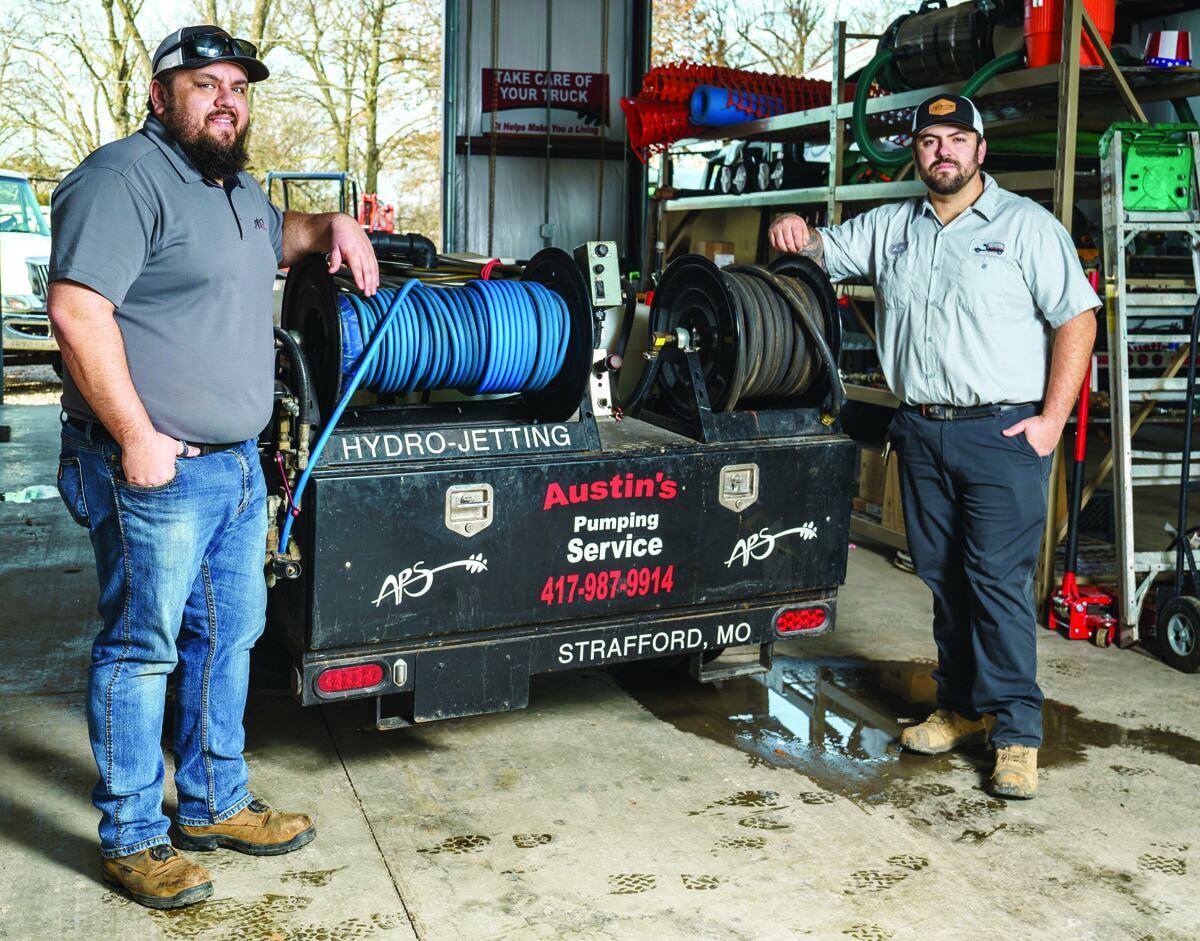
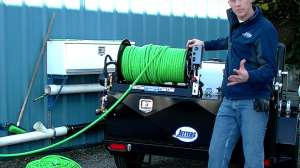
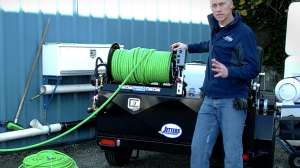
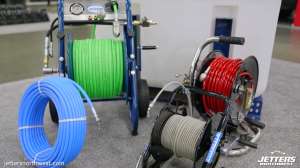
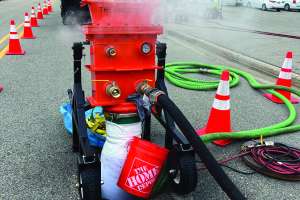
The trucks share a pair of portable drum vacuum units for grease traps, custom built in the shop, and an Eagle 200 trailer jetter from Jetters Northwest clears out major blockages.
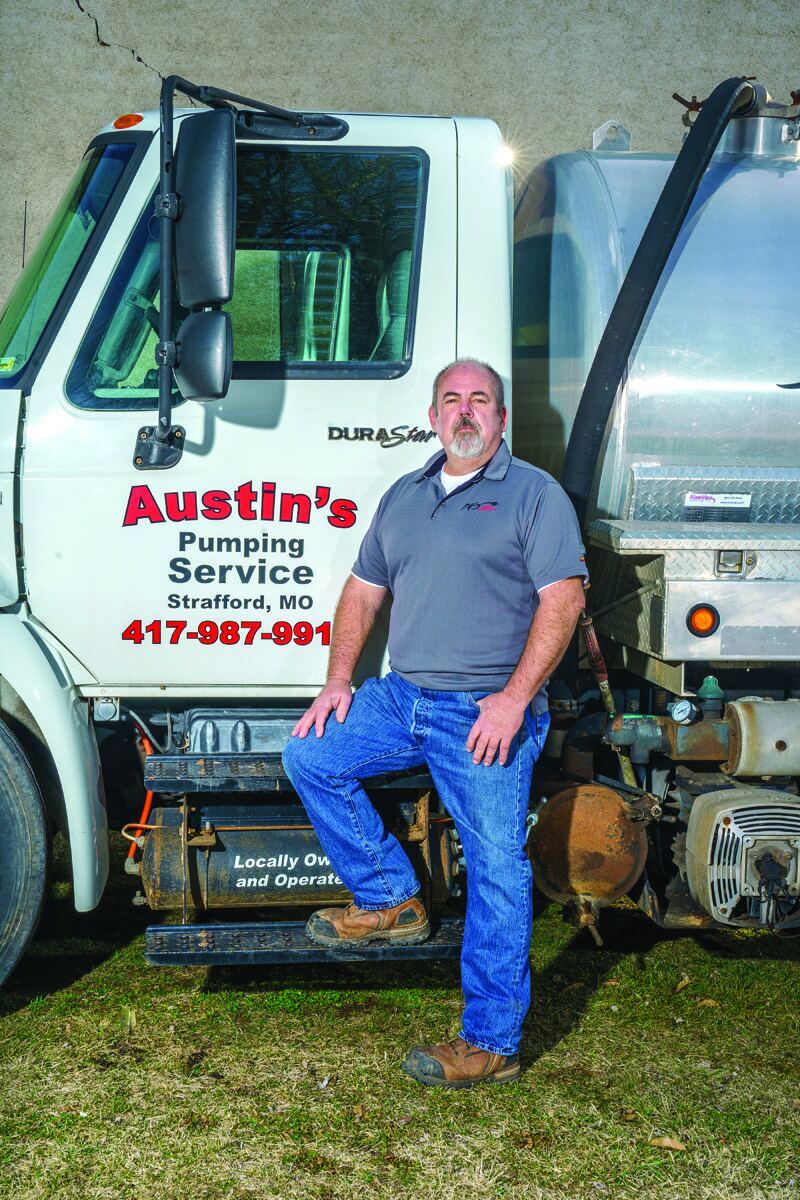
Austin’s Pumping also follows through on its promise to implement increased professionalism in the business from new uniforms to ensuring vehicles are kept scrupulously clean and clearly labeled with the company logo. Most of the company’s service workers are cross-trained so they can cover for each other.
“Plumbing goes hand in hand with pumping,” Crow says. “For example, a lot of the restaurants that require grease pumping also require plumbing service work. Cross-training makes a lot of sense so we can back each other up for manpower.”
Workers can pursue certifications for specific jobs: Missouri septic installer, septic inspector and well inspector; manufacturer training for working on specific grease traps; backflow technician; and pipefitting and gas fitting. The company’s incentive for employees: “The more you learn, the more you earn.”
For years, Hurrelbrink has been a member of the Missouri Smallflows Organization, a nonprofit organization dedicated to bringing educational opportunities to wastewater professionals in the state. He’s taught a course to help share his professionalism with others: “Inspections: Tools of the Trade.”
“My focus is explaining that if you get into inspections, don’t go in partway because you won’t be able to do the job properly,” he says. “Get your education, get your credentials, spend time with seasoned people and buy the right tools. Know the resources you’re going to need before you start.”
Always improving
Hurrelbrink also builds on his professionalism by attending the Water & Wastewater Equipment, Treatment & Transport (WWETT) Show whenever he can. He’s made it a goal to attend at least every other year.
“We like to see if there’s anything new that will help improve our efficiency or service,” he says. “I was told a long time ago by my uncle that you need to go to these trade shows because if you come back with even one idea or one suggestion that makes your company better, the whole trip was worth it.”