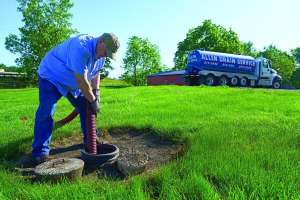
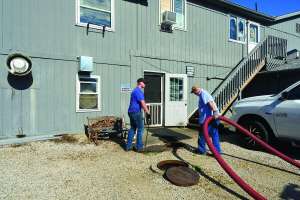
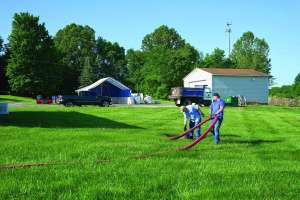
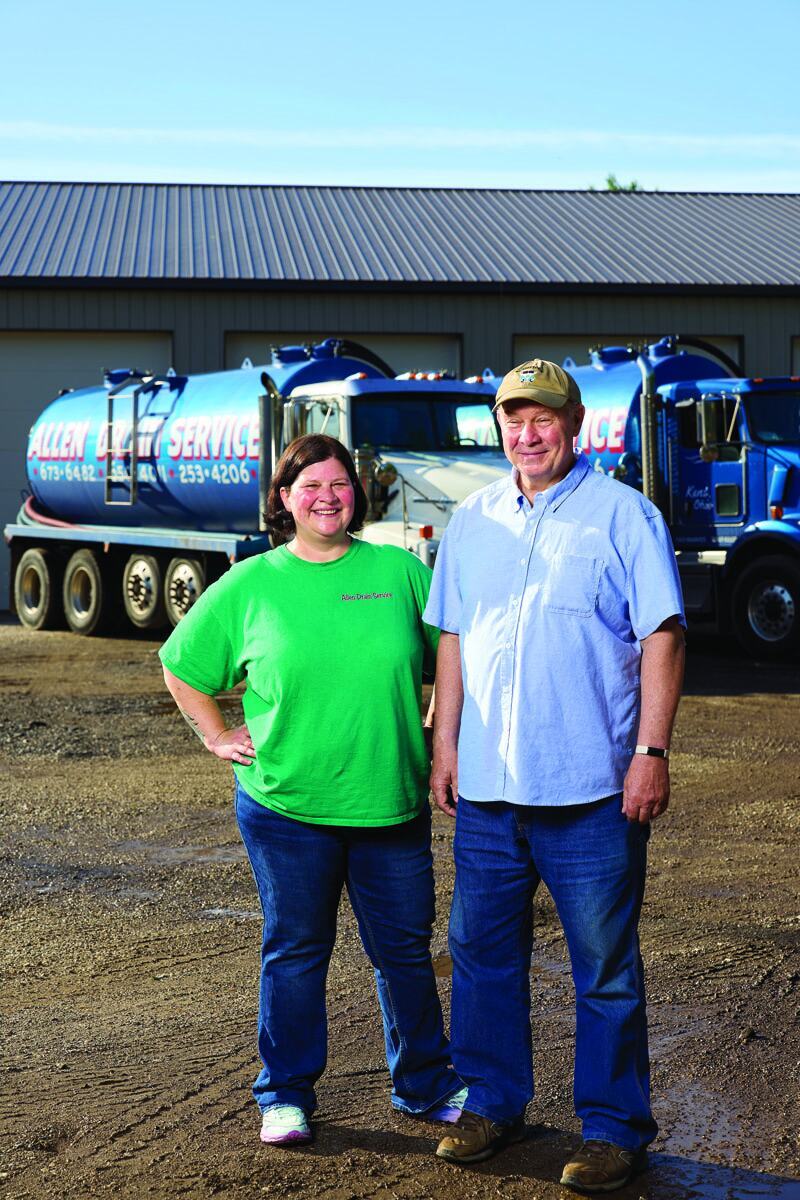
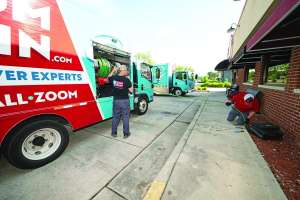
Nick Rothaermel runs the pump on the truck while Allen Drain owner Bernie Noble guides the hose on a septic pumping job. The company runs vacuum pumps from Wallenstein (a brand owned by Elmira Machine Industries) and Challenger blowers from National Vacuum Equipment on the trucks in its fleet.
Photography by Roger Mastroianni
Bernie Noble says the worst business decision he ever made was leaving Allen Drain Service to start an excavation business in 1985.
But he got a shot at redemption in 2001, when Allen Drain — based in Kent, located just outside of Akron in northeastern Ohio — was put up for sale. Noble decided to buy the business, which pumps out septic tanks and grease traps and cleans drainlines.
Since then, Noble and his daughter, Sara Gless, the company’s vice president, have focused on taking a solid, family-owned company and making it even bigger and better.
“We basically maintained the existing business model: supply excellent service at a fair price and don’t upsell to customers,” says Noble, 67. “We’d probably be more profitable if we did upselling. But we’re content just to save the world, one drain at a time. Basically, if it ain’t broke, don’t fix it.”
That’s not to say that nothing has changed at Allen Drain over the past 24 years. The number of employees has almost quadrupled, to 15 from four; its fleet of vacuum trucks and service vehicles has grown substantially; and company revenue has roughly quadrupled, too.
Furthermore, as the company’s reputation for honesty and reliable service grew, it expanded its geographic market to meet growing demand, fueled by word-of-mouth referrals and radio and television advertising.
“I’m in the background of the TV ads — they put the good-looking people up front,” Noble quips.
Today, septic tank and grease trap pumping generates about 60% of the company’s revenue while drain cleaning contributes the balance. About 70% of the drain cleaning centers on residential lines. Technology has changed dramatically, too.
“We’ve gone from doing things the hard way to using sewer jetters and descaling machines,” Noble says. “We’ve just kept up with the times. When they came out with sewer jets, we bought them. When they came out with [inspection] cameras, we bought them. When they came out with descaling machines, we bought them.
“You have to keep up with new technology in order to succeed.”
Allen Drain was established in 1942 by Gless’s great-grandfather, William Ross Allen, a farmer who started out cleaning drainlines using a 1935 Buick as a service vehicle. In 1952, the company bought its first vacuum truck and started pumping septic tanks, Noble says.
Noble was hired in 1975, then left 10 years later to start his excavation company with Allen Drain being a steady customer. At that time Allen’s son, William Charles Allen, was owner, having taken on the lead role for the company in 1961.
Noble — whose entrepreneurial resume also has included an environmental cleanup business, an ice cream shop, a trailer-sales company, and most recently co-ownership of a restaurant in Kent — bought the company in 2001 when William Charles Allen retired.
“I had worked hand in hand with the Allens for years, knew the business and got along with everybody,” Noble says.
In 2008, Noble closed the excavating business alongside the real estate downturn, which dramatically drove down demand for work. But Allen Drain continued to thrive, driven by the addition of 24-hour emergency service and a continually growing reputation for honesty.
“We get a lot of second-opinion jobs, especially in drain cleaning after another company tells someone they need to replace their sewer line for, say, $35,000,” Noble says. “And offering emergency services is really big because a lot of other companies don’t work nights and weekends. So when customers really need us, we just say yes and do jobs for a fair price.”
A great team of employees has also fueled success. Noble prides himself on the company’s ability to retain employees and keep turnover to a minimum.
“Most of them have been with us a long time,” he says. “In fact, we’ve had four employees retire from here and the last one had been with us for 38 years.”
Another employee started working for Noble part time during summers while in high school, quit to attend college and then came back to the company. He’s now been an employee for 10 years.
“I keep telling myself we must be doing something right,” Noble says.
He says he believes his company sees low turnover because he works side by side with his employees.
“I’m not like a boss that sits in an office and never sees them,” Noble says. “I literally work with them every day and know them well and try to be a good fellow employee. I think they respect me more for that, though I’m not sure I want to ask them if that’s true. All I know is that it’s fun working as a team, especially when you have good people.”
The company now owns seven vacuum trucks, compared to two when Noble bought the business. The trucks are built out on Kenworth and Western Star chassis and generally feature 4,500-gallon waste tanks made out of steel; vacuum pumps from Wallenstein (a brand owned by Elmira Machine Industries) and Challenger blowers from National Vacuum Equipment.
Two of the vac trucks are dedicated to cleaning grease traps and the rest are devoted to septic pumping, Noble says.
“We clean more grease traps now and clean them more often,” he says. “Restaurants operate on pretty tight margins, so people tend to ignore their grease traps until they have a backup. But now local health departments are mandating that they pump more often.”
The company disposes grease at a treatment facility in Cleveland, which typically involves about a 2 1/2-hour round trip. Pumping grease traps also requires a lot of paperwork, Noble notes.
Nonetheless, he says grease trap cleaning is a good and profitable complementary business for companies that want to diversify. But he suggests dedicating a truck to only pumping out grease traps because not all treatment plants are licensed to accept grease trap waste, so contractors can’t combine the two waste streams.”
To clean drains, the company relies on 10 Nissan NV200 service vans, compared to three service vehicles when Noble bought the company. It also owns two jetters from John Bean (a brand owned by Durand-Wayland), one with a 1,500-gallon water tank and one with a 2,000-gallon water tank.
The jetters were built out on Ford and Mack truck chassis, are equipped with John Bean pumps (2,200 psi at 70 gpm and 3,200 psi at 49 gpm) and are used mostly to clean sanitary and storm sewers.
“The jetters really opened up a lot more business for us,” Noble says. “A lot of our customers call them miracle machines. They really increase your ability to do jobs a little better while also increasing revenue. They also clean storm drains better — they open up your ability to gain more business.”
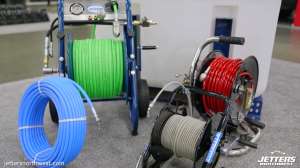
Allen Drain also owns three cart-mounted jetters from Electric Eel (4,000 psi at 4 gpm); drum cable drain machines from Electric Eel and RIDGID; pipeline inspection cameras from RIDGID and Milwaukee Tool; and several descaling machines from GI Industries.
Many companies opt for a vinyl wrap after buying a new service vehicle, but not Noble. Instead, he calls Duane Workman, an artist who’s been hand-painting letters on trucks the old-fashioned way for decades.
“The man is an artist — he really is,” Noble says. “He hand-lettered my first dump truck and he’s lettered all of my trucks ever since. He can do pinstriping, paint flames — just about anything you want.”
Workman, 71, says he started painting vehicles almost 50 years ago, mostly working on race cars. He raced late-model cars himself for about 30 years.
“I saw a guy lettering a race car when I was 23 years old,” Workman says. “He told me where to buy paint and brushes and said if I wanted to do it myself I should start practicing. So that’s what I did.”
Workman uses 1 Shot sign painter’s enamel paint and paintbrushes made from Russian blue-squirrel tail hairs, which are very fine.
“Those brushes hold a lot of paint and are very square, which makes jobs so much easier,” Workman says.
The paint dries in about six hours and is extremely durable, and requires no sealer to preserve it. He typically paints trucks at his customers’ businesses. On average, it takes him two days to letter a truck. He uses a water-soluble pencil and a yardstick to lay out letters on a vehicle. He’s lettered so many vehicles — at least a couple thousand, he estimates, including more than 50 for Noble alone — that it only takes him about a half-hour to map out a lettering scheme.
“I don’t charge an arm and a leg for what I do. My only overhead is cans of paint and brushes,” Workman says.
Workman says he believes that hand-painted letters help fulfill people’s nostalgic yearning for authenticity and artisanship. In fact, some customers ask him to either paint old-fashioned-looking letters or make letters look worn and aged. Moreover, he’s the only painter in a large geographic area that still practices the craft.
Looking ahead, Noble says he wants to keep expanding the business.
“If you’re not growing, you’re dying — and I want to keep living,” he jokes. “So we’ll keep growing, whatever that looks like. I think there’s room for more growth in our market. And we’ll achieve that by basically doing the same thing we’ve been doing — providing excellent work at a fair price.”
As for slowing down, Noble won’t be buying a rocking chair any time soon.
“I have no plans to retire,” he says. “I like to stay busy. I feel very fortunate and I’m very proud of what we’ve built and of the people I work with. Sure, there’ve been a few bumps in the road here and there, but overall we’ve done well.”