
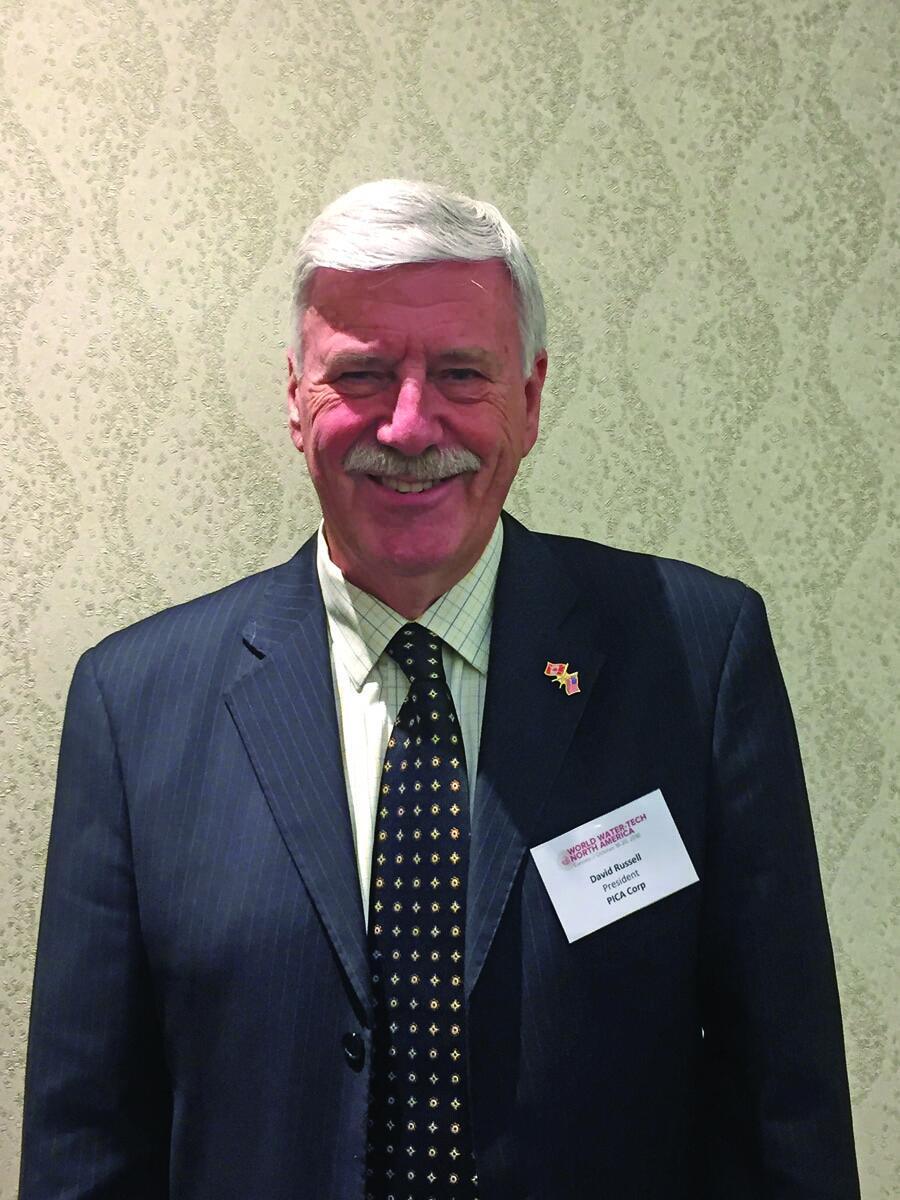
PICA Corp.’s story begins with its founder, Dave Russell, growing up in England in the 1960s and hating his banking job.
“I was just not cut out for it,” Russell says.
He received advice about getting involved in a trade instead, and in his first job at English Electric, he had his first experience with nondestructive testing — i.e. X-ray, ultrasonic and eddy current methods — doing inspections of nuclear submarine parts.
Now, all these years later with Canadian-based PICA Corp. — standing for Pipeline Inspection and Condition Analysis — Russell has further developed that expertise, establishing a successful niche manufacturing and deploying nondestructive testing tools for the water and wastewater industry to give municipalities and utilities an accurate, detailed assessment of their systems. After many years working heavily in the oil and gas industry, the water and wastewater industry now accounts for about 90% of PICA Corp.’s work.
“We’ve been working very hard to educate the industry on how it’s not an expense. It’s an investment,” Russell says. “It’s an education process, but people have been receptive. They understand the value of the technology.”

Getting started
Russell worked for English Electric for two years before emigrating to Canada in 1966. He started in Toronto and gradually worked his way west, working for other companies in nondestructive testing before eventually settling in Edmonton, Alberta, and starting his own venture, Russell NDE Systems, in 1972.
“At that time in the 1970s, oil and gas was booming and there was a big need for nondestructive testing,” Russell says. “I started working out of a van, doing ultrasonic inspections of pressure vessels and piping. Then I took on X-ray and that was a big growth area.”
By 1984, the company was doing well with about 50 employees. Russell had been using eddy current to inspect nonferrous heat exchanger tubes, but he came to the realization that the bulk of the opportunity was in carbon steel heat-exchanger tubes.
“There was no other method besides ultrasonic that would work on them so I was on the lookout for a new technique,” Russell says. “Then Shell Technologies of Houston came out with a technology they developed called remote field. We contacted them and went down there and ended up paying a small licensing fee that allowed us to develop it for other applications. We still sell that instrument — our ferroscope — around the world to inspect heat-exchanger tubes."
Diving into water and wastewater
Around 1990, Russell NDE was approached by the American Water Works Association, inquiring about whether the remote field technology would work on cast iron and ductile iron water mains.
“We said we didn’t know, but by this time we had a team of researchers who had developed the ferroscope, and we asked them to test it on those pipes. Lo and behold, it worked just as well,” Russell says. “We went on to develop a tool called the hydroscope that went through fire hydrants on a cable, and then once in the mainline it would follow the water flow for about a kilometer. Then we’d turn off the water and pull it back.”
Once the company proved the viability of the technology on water infrastructure, it secured a five-year contract with the local water utility in Edmonton.
“That was our biggest contract yet and the genesis for the water industry. It was market pull. But historically we were focused on oil and gas prior to that,” Russell says.
Throughout the 1990s and into the 2000s, Russell NDE developed various sizes of inspection tools for the water and wastewater market, covering pipe sizes up to 10 inches.
“Not everything was through hydrant access,” Russell says. “Eventually we had tools that would swim through a pipe. The longest was 35 kilometers in one continuous run. Then we started realizing that the technology might work on really large pipes as well.”
There were some structural changes to the company during this time period. Russell NDE sold off portions of the business, which included its service branch, in 2002. But it purchased back that service component in 2008 and spun it off to form PICA Corp.
Russell NDE now focuses solely on tool development and manufacturing, mostly for PICA’s use on water and wastewater jobs, though it still makes some tools for other service companies in the oil/gas and power generation fields.
Since establishing PICA, Russell NDE has developed tools for large-diameter pipe, up to 96 inches.
“PICA has grown since 2008 to exceed Russell NDE,” Russell says. “Even though we have about 25 people each in the two companies, PICA is the one that is generating the most growth because the tools are fairly unique.”

How it works
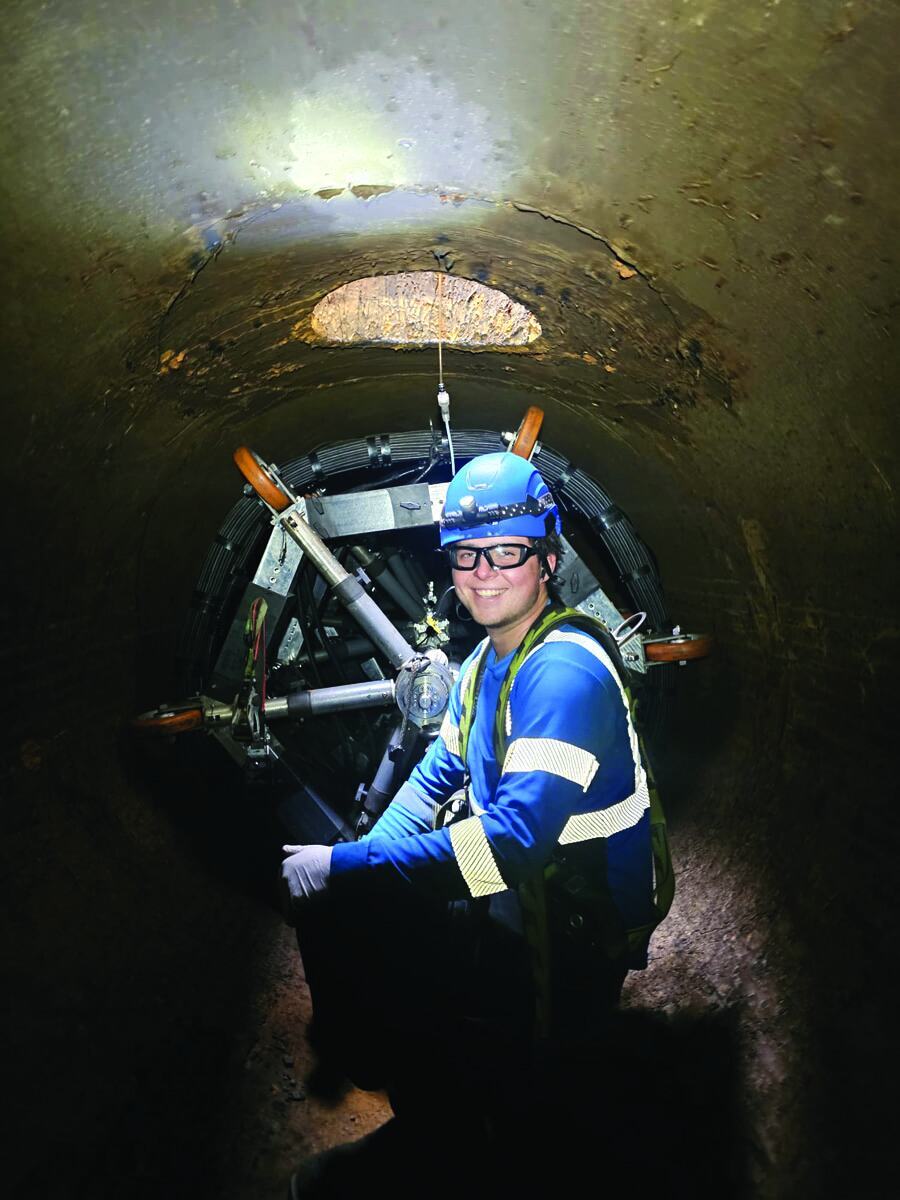
The function of PICA’s inspection tools is based around basic electromagnetic principles. Noncontact electromagnetic waves penetrate the pipe and the travel time through the pipe indicates how thick its wall is. This helps accurately locate areas of corrosion, for example.
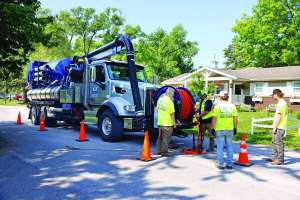
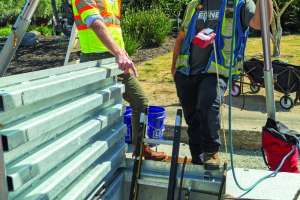
Russell uses one regular client, the water utility in Omaha, Nebraska, as an example of a typical job. PICA inspects Omaha’s force mains annually. To get the tool into the system, PICA excavates down to the force main, takes it out of service, and patches in a launcher for the tool. Water from a hydrant pushes the tool — mounted on soft rollers — through the launcher into the force main.
“Then it goes through the main to the other end, it might be a mile or 5 miles,” Russell says. “The other end has a receiver, a piece of pipe attached to the main temporarily. The tool goes into the receiver. Then we can depressure, drain off the receiver, open the end and take the tool out. Then we download the data.”
PICA analysts do a quick review of the data to identify any glaring issues the customer might need to immediately know about.
“We give them a preliminary report of the big, obvious defects on that quick review,” Russell says. “We get that to them in 48 hours. Then it takes a few weeks depending on the length and diameter of a pipe to thoroughly analyze everything. Once we’ve isolated all the defects, we produce a report of all of them — the axial location of the defect and the circumferential position. The technique is good at about plus/minus 15% for very small, local defects. It’s much better — plus/minus 5% — for corrosion. It sees that right away, wall thickness changes. Then the customer can make rehab and repair decisions off the data.”
The technology being noncontact is a key feature, Russell says.
“We can live with a half-inch to an inch of clearance around the tool if there’s, say, scale or silt buildup. We can even go more than that. The pipe can be 50% plugged with scale. We don’t necessarily like to do that. It reduces the sensitivity, but the tech will work.”
The cost to get the tools in and out of pipelines is sometimes the most challenging and expensive part of an inspection job, Russell notes. Tools can be free swimming or pulled through the pipe on a winch. PICA can do an inspection while still keeping a pipe in service.
“The inspection speed is ideal at 5 to 10 feet per minute, but flows are usually much faster than that,” Russell says. “But if we reduce the pressure and the flow, we can leave a pipe in service, particularly in cases where there’s no redundancy.”
Smaller tools are launched in the pipe in their full form, but the tools for larger pipes — 22 inches and up — are broken down into components that are assembled by the crew on site in the pipe.
“We’re always evolving the tools, but the basic electromagnetic theory is the same on all of them,” Russell says.
Best of both worlds
Being involved in the engineering and manufacturing side as well as the service side has been a boon for PICA.
“I think we have the best of both worlds because we not only design everything — the mechanical, the electronics, the software — but we also get to assemble it all and ensure it’s working properly,” Russell says. “We have a big yard [in Edmonton], pipes of all different sizes that we test the tools on. Then the same people who are testing tools in the yard are also the ones going out on jobs.”
PICA debuted a new tool on a recent job in California’s Bay Area. The tool is designed to navigate elbows in large-diameter pipe.
“It being new we were learning things about how it behaved in the pipe and we were being gentle so we didn’t break anything,” Russell says. “The field crew is kind of part of the development team as well, so we all had a stake in making the job go well. That means we didn’t push the limits until we knew it would traverse bends.”

Education and expansion
The education process for the remote field technology is something that has been a focus for PICA since its beginning and continues to be crucial as it directly ties into the company’s expansion plans.
“If you’re a small or medium-sized city, first of all, you’ve probably never heard of this kind of testing for water and wastewater mains, and also you probably don’t have a budget for it,” Russell says. “But once we get someone to try it, they’re often hooked and come back year after year.”
Russell again uses Omaha as an example.
“That’s a typical case for us,” Russell says. “Once they try it and see the benefits — that they can know exactly where their problems are and do a repair to avoid a catastrophic pipe failure — they’re in. The marketplace is slowly getting educated. We only have three salespeople, so getting around to all the municipalities is a challenge. You have to be opportunistic and knock on their door right after they suffer a major failure that was costly to fix. And small municipalities have tight budgets and don’t have their own inspection people or an understanding of how the tech works, so it’s maybe a little bit stressful. You have to show that inspection is a good investment.”
Customer education is the main hurdle because Russell says PICA doesn’t have many direct competitors.
“We have a handful of competitors, but this type of testing is very capital intensive, and then there’s a steep learning curve.”
PICA works globally, but the company is mostly directing expansion plans to the North American market for the foreseeable future. Alongside its Canadian headquarters, PICA maintains a U.S. home base in Denver, Colorado. Russell says the hope is to expand to several more locations in the coming years.
“Arizona and California are hot spots for us, but we have jobs scattered throughout the U.S. We’re expecting that in five years we’ll have doubled our employees and tripled our revenue in the U.S. Although we can take up to three jobs at the same time, at the moment we have to really plan and schedule crews sequentially. We want to get better at emergency response.”
Russell says there have often been surprises when PICA has taken on jobs in far-off locales.
“We had one job in China where we got the tool there OK, but when we went to ship it back, they had changed the rules on shipping batteries. It was when they first recognized lithium-ion batteries could be hazards on airplanes, so they stopped air shipment and we were stuck shipping that tool back by sea, which took about three months. We’re still taking on jobs like those for existing customers, but we’re focusing our sales effort on North America and keeping our mobilization expenses in check.”

Future plans
Russell says he has been very focused on building out the technology PICA needs over the past two decades, investing a lot of cash flow back into the company, that another goal, in addition to the expansion plans, is to shore up the company’s financials.
“We’ve tended to spend every dollar we make on making new tools,” Russell says. “But now we kind of have all the tools we foresee that we need. We will be duplicating tools and making improvements, but we don’t have to develop any new technologies. Now we need to put some money away so we can weather storms better.”
And personally, Russell, now 78, says he plans on staying involved with what he launched a half-century ago, even if his role changes. He says going forward he’s focusing more on Russell NDE and less on the daily operations of PICA.
“Russell NDE is busy making tools for PICA, so that’s a full-time job, just managing that process. And I have a good right-hand man, Evan West, managing PICA. He’s taken a lot off my back.
“But I love working,” he adds. “I realize there’s going to come a time when I’ll have to retire, but as long as I can keep working, I will.”
Russell also likes that Russell NDE and PICA have been able to be family ventures. For many years, his wife, Julie, handled all the bookkeeping, invoicing and phone answering. Today, he has two sons and a grandson working as technicians and project leaders. And his daughter, who works for a local Edmonton college, is involved on a part-time basis as safety officer.
“It’s exciting to see them doing something with what we started 50 years ago,” Russell says.
Continue reading for free