“I thought I would do drains on the side,” Watkins says. “So I bought an Electric Eel snake and started doing that. Before I knew it, I was getting referrals.”
Getting Serious
By 2017, Watkins was ready to take his side project to a new level and registered as an LLC under the name Watkins Drain Cleaning.
“At that time, being in my 20s, I didn’t know what I wanted to do, whether I wanted to stay focused on septic or the drain work,” he says. “After nine years, and referrals coming in, I just decided one day that, instead of making this a little side hustle, I should turn it into a business and see where it goes from there.”
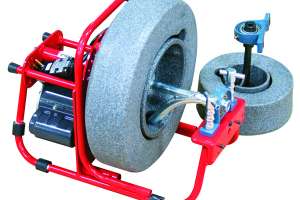
Watkins sold his Electric Eel snake and at the 2017 Water & Wastewater Equipment, Treatment & Transport Show he bought a Spartan Tool 300 cable drain cleaning machine.
“I tried it out, liked it, and from there I advanced and bought a Spartan 100 for doing kitchen sinks and floor drains,” he says. “And then I ended up needing a bigger snake so I got the 1065 with 150 feet of 3/4-inch cable for long sewer runs.”
Watkins also upgraded from a 5-by-10-foot enclosed Cargo Express trailer to a 2017 Chevy Express panel van.
Diversifying
Watkins knew it would be difficult to rely solely on drain cleaning to make a living. So he bought a 2019 International 607 vacuum truck from Imperial Industries with a 3,600-gallon steel tank and a National Vacuum Equipment 607 Challenger pump. In 2019, four decades after his grandfather started a septic company, Watkins was proud to be doing the same.
To get exposure for his new business, Watkins relied on word-of-mouth, Google, social media, business cards and the benefit of having a well-known name in the industry.
“People could see on social media and local community pages that the grandson of Watkins is now running a business doing drain cleaning and septic pumping,” he says.
Business was good the first half of the year, but really took off during the latter half due to a stroke of luck.
“At the end of the year I was able to buy back my grandfather’s name and phone number from the septic company he had sold it to,” Watkins says. “So that’s when we became Watkins Septic & Drain LLC. It made a huge difference.”
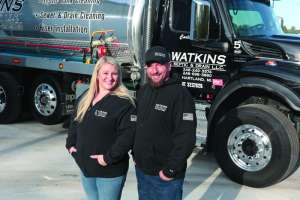
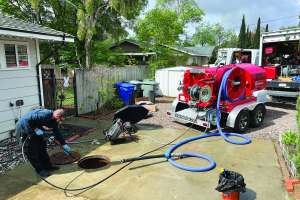
Today Watkins operates the business with his wife Carli in Hartland, Michigan, northwest of Detroit, serving residential and commercial customers. They recently built a heated barn on their property for equipment storage and office space. Carli handles bookkeeping, phone calls and other office work. An employee does the septic pumping, and Watkins says he bounces around among septic pumping, installing risers, replacing broken sewage lines, snaking and jetting.
Down the Drain
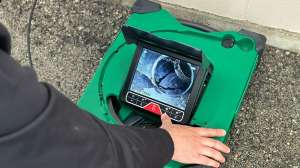
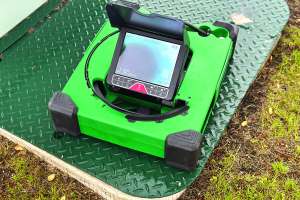
Drain cleaning is about 30% of the company’s work. Additional equipment picked up along the way includes two RIDGID SeeSnake cameras, a smaller one for sink drains and a larger one for sewer mains; and a RIDGID FlexShaft K9-306 drain cleaning machine, used mainly to knock the scale and rust out of cast iron pipes.
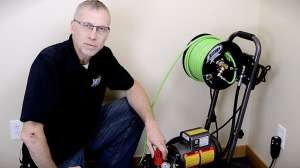
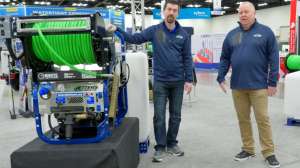
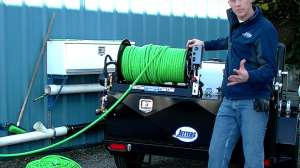
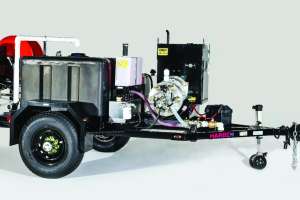
The couple continues to attend the WWETT Show in order to keep up with what’s new in the industry. And they almost always buy something, Watkins says. In 2023 it was a Jetters Northwest Brute jetter — 9 gpm and 4,000 psi, with a Warthog nozzle from StoneAge — to replace a Spartan 758 trailered jetter purchased in 2018.
“We wanted something that could be in the van with us at all times,” Watkins says. “We bought a new van and skid-mounted the jetter in it. That led to more jetting sales than snaking. And we ended up jetting a lot more drains since we had the convenience of it being in the van versus going out to a job, seeing that we needed a jetter, and then going back to the shop to get it.”
The van is a 2023 Ram ProMaster 3500 with a mid roof and long wheel base. Watkins had it outfitted with a Milwaukee Tool PACKOUT modular storage system.
“We didn’t want the standard van shelves because it took up too much floor space,” he explains. “So this leaves us with plenty of floor space for the snakes and cameras.”
Watkins says there are some challenges to the work.
“One of the most frustrating things is some houses have no clean-out caps for access without having to take the plumbing apart or remove toilets. Or they put the clean-out in a crawl space. You can’t take your snakes in crawl spaces a lot of times because of their size. You’re lying down there taking a cap off and sewage comes out, and you can’t run away from it. We prefer everybody to have an outside sewer clean-out sticking out of the ground.”
Watkins says it’s also hard to compete with big-name companies that offer $99 specials, then try to upsell their services.
He says he’s seen it all but one of the worst jobs he did was for a family on city sewer who used nothing but wet wipes — no toilet tissue. The call came in at 9 p.m.
“The sewer was so backed up that we pulled out a whole contractor trash bag of wipes wrapped around our cable. It took us a couple hours to get the line unplugged. The city even brought their Vactor out and vacuumed them out of the main.”
Getting Pumped
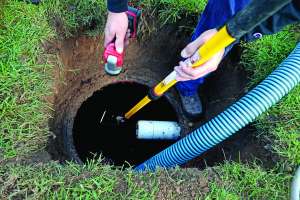
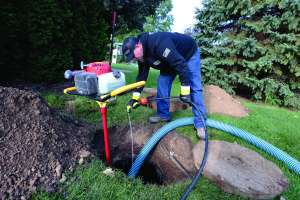
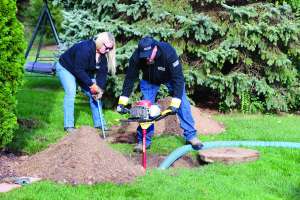
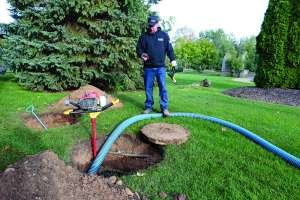
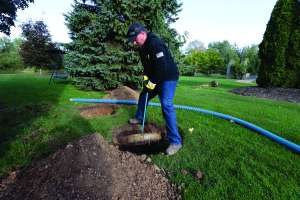
Equipment on the septic side includes a Crust Buster tank agitator, T&T Tools probes and hooks, and Prototek and Milwaukee locators. They also have a 2020 Bobcat E20 mini excavator used for digging up deeply buried septic tanks or broken sewage lines.
More people are having risers installed, Watkins notes. They did about 400 in 2023. Some real estate inspectors recommend them, so buyers are starting to request them. And with dig fees going up, they often pay for themselves.
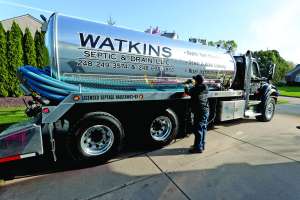
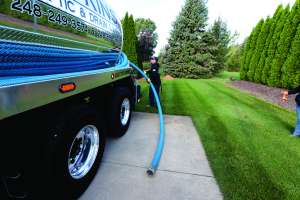
Watkins sold his 2019 vacuum truck in January 2023 and bought two new ones. One is a 2023 International HV607 built out by Imperial with a 4,250-gallon aluminum tank, an NVE 4310 blower and a flowmeter. It also carries a 100-gallon water tank with a garden hose reel used to wash filters and clean tools and equipment.
A few months later he bought another 2023 International HV607 from Imperial with a 4,050-gallon waste/200-gallon freshwater aluminum tank and an NVE 4310 blower.
“That was the truck at the 2023 WWETT Show,” Watkins says. “Imperial had it on display. It has a PTO-driven jetter with a Cat pump, a garden hose, a flowmeter, and a trailer hitch to pull the excavator. It also has a remote system so you can remotely turn the pump on and off, open and close the valves, and run the jetter.”
Watkins is passionate about keeping the trucks clean and maintained, which he believes helps a lot in reducing the effects of wear and tear. Trucks are washed at least weekly, and more often when chloride products are put on the roads.
All septage is taken to the local treatment plant, about 12 minutes from their shop.
Controlled Growth
Watkins says it has worked out well maintaining both septic and drain cleaning services.
“It’s a big help, especially through the winter months when septic pumping is slow,” he says. “And when we do emergency services to pump septic tanks that are backing up, it may be that the septic is not the issue, it’s the drain. So we can take care of the problem, whether it’s the drain or the septic. We don’t see many companies in our area that do both.”
Future plans include continuing to grow the business and possibly add other services such as septic installations. But, having experienced situations like the 2008 economic recession, Watkins says he wants to be careful about growing too fast.
There is also the labor situation to consider. They don’t want to overwhelm themselves with work if they can’t find help. As in many areas of the country, it’s hard to find and keep employees, Watkins says. And employees are quick to change jobs if someone offers even slightly more pay.
While the business sometimes has its challenges — low profit margins on septic work, having to dig up lids to pump tanks, and lowball pricing by competitors — Watkins says has no regrets. He loves being his own boss, making the decisions, and being a third-generation operator.