
One solution is to use epoxy resins, which don’t contain styrene, but they can cost considerably more.


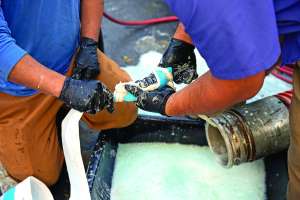
One solution is to use epoxy resins, which don’t contain styrene, but they can cost considerably more.
Cured-in-place pipe lining has been around for more than 50 years, and for just as long, fumes emanating from styrene-based resins in the linings have concerned installers and some public health officials. The good news is that there are ways to mitigate the emissions.
The culprit is styrene, a liquid compound utilized in synthetic rubber and plastic. More to the point, styrene is in the resins that cure, harden and adhere lining to pipe interiors. Because styrene resins work well and are relatively inexpensive, many CIPP installations employ material containing the petroleum product.
Yet the fumes remain a problem. They are emitted during the CIPP installation process and, if they are inhaled in sufficient amounts, they can affect the inhaler’s balance, concentration, color vision and reaction times. Anything that thus impairs workplace performance becomes a health and safety issue, in a municipal setting or anywhere else.
The rest of the story is that the emissions usually are a momentary event. If a resin, for some reason, is incompletely cured during the lining process, there is a chance for lingering fumes, but that’s not the rule. That may be small comfort to lining crews smelling it in real time.
Styrene emissions must be present in concentrations more than a thousand times greater than found in the natural environment to pose a threat, according to a U.S. Department of Health and Human Services report. So the fumes emitted during installation mostly are noisome. Still, it is recommended that total exposure of laborers be kept below EPA-recommended levels.
Be that as it may, the stuff smells. That alone is nettling to contractors, property owners and municipal managers, some of whom worry about adjacent populations being exposed to threatening concentrations of the gas. What can be done?
One solution is to use epoxy resins, which don’t contain styrene. Problem solved. Non-styrene resins have been available and in use for two decades. Unfortunately, there are other considerations with that choice, with perhaps the main one being cost. Resins without styrene can cost considerably more.
There are additional considerations. Different CIPP resins vary in their mechanical properties — things like a cured lining’s hardness, flexibility and corrosion resistance. Different resins also respond differently to curing methods — that is, to hot water, steam or ultraviolet light. So, curing speed and the ultimate properties of the cured lining are factors to consider in looking at nonstyrene lining agents.
A second solution to reducing vapors is to employ a so-called “barrier product,” a coating that seals the styrene odor in a liner so it can’t migrate into ambient air — neither during installation of the liner nor afterward.
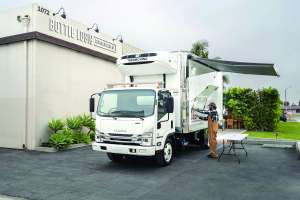
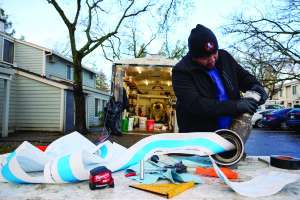
To test the performance of the barriers, an industry study was undertaken recently. It drew upon the fact that styrene fumes are most noticeable during the insertion process and when refrigerated trucks containing infused liners are opened at the job site.
In the study, some trucks were loaded with styrene-infused lining and some with identical lining that had been coated by the barrier product. When the trucks were unsealed, their relative concentrations of styrene fumes were detected and recorded.
“It was a night-and-day difference,” says Lance Cullen, new markets business development manager at Haartz.
The study concluded that opened trucks with unblocked lining recorded between 200 and 300 parts per million of styrene fumes, while trucks containing the coated lining registered less than 0.30 ppm.
“That’s a drop of more than 99%,” Cullen says. “People standing there with me didn’t believe there was styrene in the trucks at all.”
Cullen would, of course, tout the success of the barriers. Among the lineup of products at his company are styrene-barrier coatings. Haartz has a hundred years of specialty automotive fabric experience in which coatings and adhesives are an integral feature. The company had its CIPP barrier products under development for five years and began marketing them two years ago.
Other companies also produce barrier products and the effectiveness of such coatings is widely acknowledged. They can be designed to be compatible with particular curing methods and are durable enough to withstand an abrasive flow of liquids through a pipe. Cullen says Haartz barriers, for example, have been tested for adhesion and durability and are deemed able to support the 50-year design life of lining.
Cullen says that barrier coatings should be capable of withstanding the CIPP inversion process and be flexible enough to “dimple” when the lining passes an intersecting line, so that the covered opening can subsequently be found and reinstated.
He also strongly recommends using two barriers — one affixed to the wall of the pipe before the lining is inserted, the other on the interior of the lining so the lining is sandwiched between the barriers. However, the pre-liner barrier is considered optional.
The bottom line: There are choices for dealing with concerns about CIPP fumes. A nonstyrene resin can be used in the lining, or a barrier product can be affixed to the lining. Depending on the size of a project and lining material selected, using a barrier could be less expensive than lining a pipe with a nonstyrene resin.
Continue reading for free