
Municipal underground infrastructure is constantly exposed to moisture and temperature fluctuations that lead to corrosion, which creates a host of issues and increases maintenance costs. To prevent or solve these issues, selecting the right coating is crucial.
Epoxy advantages and limitations
Both epoxy and polyurea are two-component coating systems, so which one is better? That answer has a lot to do with the temperature and humidity at the time of application. Epoxy coatings create a hard, protective layer that resists chemical exposure and corrosion. But very often, if the temperature of the metal and temperature of the exterior are too close together, the epoxy’s adhesion will fail.
Advantages of epoxy:
- Strong adhesion – Bonds well to properly prepared surfaces, providing effective protection
- Chemical resistance – Withstands exposure to many water treatment chemicals
- Proven track record – Decades of use in applications, particularly when the temperature is constant
Limitations of epoxy:
- Long curing time – Epoxies can take days to fully cure, delaying return to service
- Rigid composition – Prone to cracking, chipping and wear when subjected to movement or temperature changes
- Surface preparation sensitivity – Requires the right temp and humidity levels to ensure adhesion
- Environmental susceptibility – Epoxy can be more susceptible to wear in very acidic or low PH environments, as well as continuous exposure to grit and sand
Polyurea advantages and limitations
Polyurea coatings have gained popularity due to their flexibility, rapid curing time, and enhanced resistance to environmental factors. Unlike epoxy, polyurea remains elastic, making it ideal for applications exposed to structural movement or extreme weather conditions.
Advantages of polyurea:
- Fast curing time – Dries in 30 seconds, allowing structures to return to service quickly
- Superior flexibility – Withstands structural shifts and prevents microcracking
- High chemical resistance – Protects against water treatment chemicals and contaminants
Limitations of polyurea:
- Specialized application – Requires trained professionals for proper application
- Higher initial cost – Often more expensive upfront but can lead to long-term savings due to less maintenance
Why choose polyurea over epoxy?
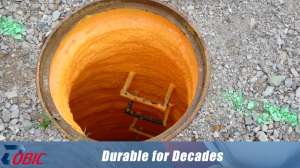
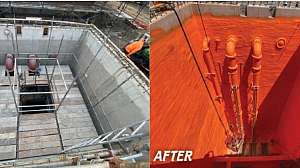
For applications where the substrate is prone to movement or flexing, epoxy may not be the best choice. This is where polyurea becomes the preferred solution. In the manhole repair space, we've seen thousands of cases where epoxy coatings failed due to freeze-thaw cycles and environmental stress. Because manholes are underground, they experience extreme conditions that can cause epoxy to crack and deteriorate. Municipalities often reach out after just a year or two, reporting epoxy failures and requesting polyurea as a more durable solution. While epoxy coatings may hold up if they survive the initial freeze-thaw cycle, polyurea offers a proven, long-term performance advantage.
Polyurea may be the best choice if return to service is your primary concern. While epoxy coatings may take one to two days to fully cure, polyurea cures in just 30 seconds — dramatically reducing downtime and ensuring a faster return to service. This rapid cure time makes polyurea a game-changer for that.
The OBIC advantage
The OBIC Armor Multi-Layer System is built to protect and designed to perform for decades. OBIC Armor provides a fast, easy and cost-effective method for repairing and preventing damage to municipal and industrial sewers, as well as potable water systems. The spray-applied OBIC 1000 (flexible polyurea) cures quickly, making it an ideal choice for rehabilitation projects.