
There is an ongoing challenge when maintaining large-diameter sewer pipes. As time passes, mud, sludge, sand, and gravel can accumulate along the bottom of the pipe, restricting the smooth flow of water. If left unresolved, pipe blockages can cause water to overflow into streets, basements, and public areas, while also driving up long-term maintenance expenses.
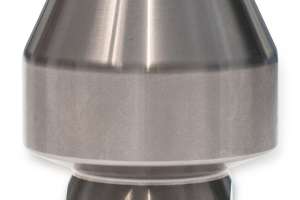
Utilities have traditionally relied on Venturi nozzles to effectively clear sediment and debris from the bottom of sewer lines. This specialized attachment operates on the Venturi principle, which states that when fluid passes through a narrowed section (channels in the nozzle), its velocity rises while its pressure drops. By harnessing the flow of water already in the pipe, the nozzle increases pressure and produces a high-velocity stream strong enough to break apart and dislodge accumulated material. This makes the Venturi nozzle more effective for debris removal than a conventional jet nozzle.
Unfortunately, Venturi nozzles are widely acknowledged to perform below expectations. Although the nozzle vigorously churns water within the pipe, the collected debris at the bottom often does not get fully dislodged and vacuumed out.
According to Dan Story, trainer and operations manager at KEG Technologies, a manufacturer of Tier 1 to Tier 3 nozzles, chain cutters, floor cleaners and camera nozzle systems, the issue is in the positioning of the Venturi nozzle inside the pipe.
“A traditional Venturi nozzle does not target the debris directly; instead, it channels the water flow toward the center of the pipe,” Story explains. “As a result, you end up just moving a lot of water and only a little bit of the material at the bottom.”
Recognizing this shortcoming inspired KEG Technologies to design a more effective methodology for cleaning the bottom of large-diameter pipes.
Story’s research led him to look beyond the nozzle and evaluate the skid that supports it as it moves through the pipe. To maintain stability during high-volume jetting, the water flow must be pointed directly into the material to break it up. As a result, the high volume of water flow moves the debris faster down the line. A Venturi nozzle must have a full pipe of water because if air is sucked into it, the nozzle stops working.
“Improving the effectiveness of a nozzle required modifying the skid,” Story says. “By changing the angle of the skid, the churning water can be directed at the collected debris. The pressure drop [as a result of the Venturi effect] also creates suction, pulling surrounding water and debris toward the nozzle and then moving it through the pipe back to the vacuum truck. In effect, the nozzle both dislodges and transports debris at the same time.”
This innovation builds on earlier advancements in skid design that KEG Technologies has introduced to the industrial pipe cleaning sector. In recent years, the company has introduced lightweight aluminum skids that can be used with its patented high efficiency Tier 3 nozzle (rated at 75-98% water efficiency). Switching from steel to aluminum construction significantly lowers the overall weight, making the nozzle easier for operators to maneuver inside the pipe.
Additional skid design enhancements from KEG Technologies include the introduction of protruding plastic fins for greater stability and shaping the skid like a football to reduce the risk of snagging on sewer pipe obstructions and protect liners in the pipe.
Today, the company offers steel and aluminum skids in a variety of sizes with 12-inch pipe applications being among the most popular.
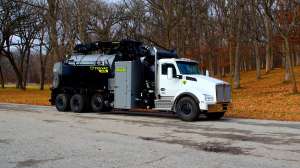
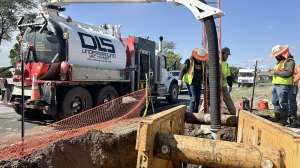
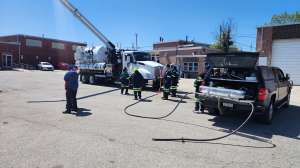
KEG Technologies recently demonstrated its Venturi nozzle and redesigned skid to wastewater maintenance crews and municipal sewer operations teams in Orange County, California. The county was in the process of drafting specifications to define the optimal approach for cleaning out large-diameter pipes before putting the project out for contract.
Not only did the test validate the effectiveness of the new design, it also yielded further insights into how to refine the skid design to make it easier to maneuver within the pipe.
Today, KEG pairs its skid with its Venturi nozzles, which are ideal for industrial sewer pipes of 18 to 36 inches in diameter. In doing so, the nozzle can increase the flow rate of vacuum trucks from 60-100 gpm to approximately 400 gpm to break up and dislodge heavy debris before suctioning it from the pipe.
By adopting the redesigned skid and Venturi nozzle system, municipalities can significantly reduce the risks associated with sediment buildup in large-diameter sewer lines. This improved cleaning approach not only dislodges but also transports debris efficiently, ensuring a cleaner pipe bottom and preventing the blockages that often lead to costly overflows, emergency responses, and reputational harm.
For more information, visit kegnozzles.com.
Continue reading for free